
Your 30-Second Summary
Mobile development in 2026 feels very different from before. A lot has changed in a short time, and .NET MAUI is becoming part of that shift. Here’s our take on why more teams are starting to take .NET MAUI seriously.
What We’re Covering:
• Business Advantages of Adopting .NET MAUI in 2026
• What this Means for Enterprises Making Mobile technology decisions today.
• How Arna Softech approached a real mobile project using .NET MAUI.
The demand for cross-platform development is hard to ignore. What was a $149.5 billion market in 2024 is projected to nearly triple to $418.2 billion by 2030. The reason is simple. Maintaining separate apps for iOS and Android is becoming harder to justify for many businesses.
How are companies solving this challenge? In 2026, .NET MAUI mobile app development is the answer many of them are landing on.
For businesses that care about shipping faster, scaling smarter, and not duplicating effort across platforms, hiring dedicated dot net developers to build with MAUI has become the obvious next step. This blog explores why this change is happening.
Why Businesses Are Choosing .NET Mobile App Development Services?
The reason why .NET MAUI is gaining traction in 2026 is backed by a couple of factors.
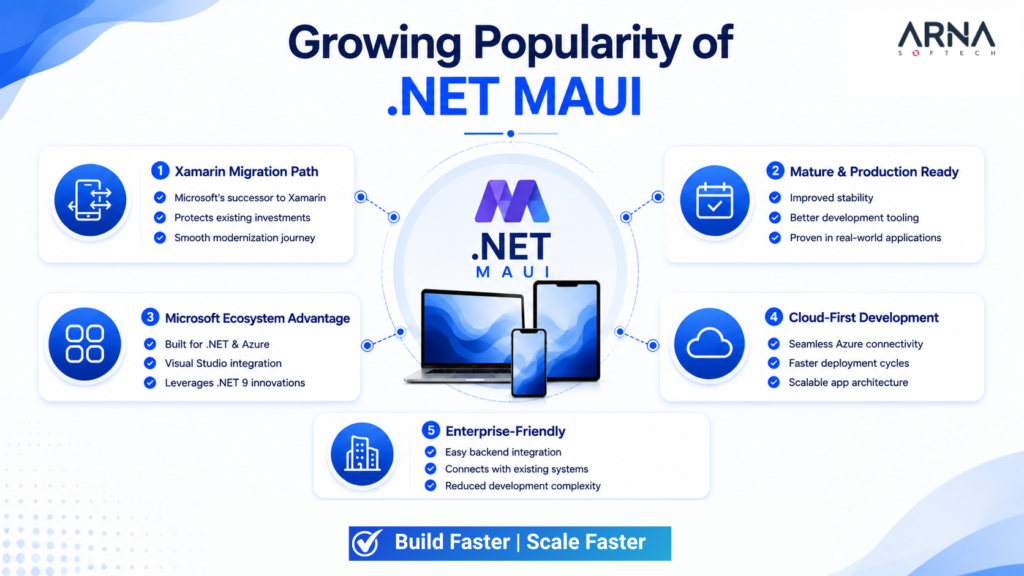
1. Xamarin’s Phase-Out Sparked the Transition
A big catalyst has been Microsoft officially moving away from Xamarin. Teams that were already in the .NET mobile ecosystem had to decide:
Do we move forward with MAUI, or shift to an entirely different stack?
For many, MAUI became the natural path forward. Because they wanted to protect existing investments while modernising them.
2. It’s Matured Beyond Early-Stage Concerns
In the first couple of years, MAUI was still evolving. Now, after multiple updates and real-world implementations, those concerns have largely settled. The framework is more stable, tooling is more reliable, and there’s enough production usage to build confidence. This changes the risk equation for businesses. It’s now established as a tech that’s proven enough to invest in.
3. Fits Naturally Into the Microsoft Ecosystem
A lot of enterprises are already deeply invested in Microsoft technologies, whether it’s .NET, Azure, or tools like Visual Studio. MAUI doesn’t ask teams to start from scratch. It doesn’t introduce a new ecosystem. It just extends the existing one. That means no need to rebuild internal capabilities around a completely new tech stack. Plus, .NET MAUI keeps pace with the future of .NET and advances in .NET 9, so those improvements flow straight into your apps.
4. Good Alignment With Cloud-First Strategies
Modern apps are closely tied to cloud services, APIs, and data layers. MAUI integrates easily with Microsoft Azure. This makes it simpler to connect authentication, storage, analytics, and backend services. For businesses, this results in faster rollout and apps designed to scale from the outset.
5. Matches the Modern Enterprise Needs Well
Apps are no longer standalone. They’re tied to cloud services, internal systems, analytics, and identity layers. This is where MAUI has an edge. Its alignment with the broader .NET ecosystem makes it easier to plug mobile apps into existing enterprise infrastructure without heavy integration effort.
Is It Time to Move Your Xamarin App to MAUI?
If your app is built on Xamarin, you should start looking at your options. Staying on an unsupported framework can make maintenance harder. It can also limit access to new platform features.
Xamarin to .NET MAUI Migration - Questions Businesses Often Ask
1. Do I Need to Rebuild My Xamarin App?
Many Xamarin apps can reuse existing business logic, APIs, backend integrations, and data layers. Migration is mostly about modernising rather than rebuilding.
2. Can Migration Cost Less Than Building a New App?
Businesses can reuse existing logic and backend systems. So migrating to .NET MAUI can offer better value for money than developing a completely new application.
3. Can Migration Cost Less Than Building a New App?
Start the conversation with a .NET MAUI development company early. They can review the application and help plan migration with confidence.
A .NET MAUI Success Story by Arna Softech
We helped a client build a .NET MAUI mobile app to simplify how vehicle repair and assistance services are handled. What we built was more than just a mobile interface. The app brings together multiple moving parts into one seamless experience:
• Real-time repairer discovery based on location.
• End-to-end request and claims tracking.
• Plan-based coverage reducing the need for upfront payments.
• Integrated navigation and support, making it easy to act quickly in time-sensitive situations.
MAUI helped us deliver an effective app across platforms without splitting development efforts. It allowed us to focus more on solving the actual user problem rather than managing multiple codebases.
Conclusion
What we’re seeing with .NET MAUI cross-platform application development isn’t just about choosing another cross-platform tool. It’s about moving toward an ecosystem-driven way of building applications with .NET at the center.
Teams are thinking more long-term now, building systems that are easy to maintain and can scale without surprises. .NET MAUI mobile app development fits neatly into that approach since it’s backed by a well-structured enterprise ecosystem.
If you’re looking to grow your .NET ecosystem with the right talent and hire dot net developers to support that journey, Arna Softech has a team ready to step in. Let’s figure out how a MAUI mobile app can be built around your Microsoft setup.
Frequently Asked Questions (FAQs)
Can .NET Be Used for Mobile Application Development?
Yes, .NET isn’t just for web or backend anymore. With .NET MAUI, it’s a strong option for building scalable mobile apps across platforms. For more information about building with .NET, check out this complete guide to .NET outsourcing.
How to Build a .NET MAUI App?
To build a .NET MAUI app:
• Start by setting up a project in Visual Studio
• Design the UI
• Write the app logic in C#
• Connect it to any backend or APIs you need
• Use one codebase across Android and iOS
Is .NET MAUI Backend or Frontend?
MAUI is frontend. It builds the app interface, while backend services are typically handled separately using .NET technologies.
How to Choose a Reliable .NET MAUI App Development Service Provider?
Start with their track record. Have they built similar apps before? Can they share case studies or success stories? The right partner should be able to guide you, not just develop your app.
Does .NET MAUI Have a Future?
Yes. MAUI is Microsoft’s path forward for cross-platform apps. It continues to receive ongoing updates and support.