Arna Soft

Insurance Automation: Driving Faster Claims Processing

By Arnasoftech

Insurance claims used to take weeks to settle. Today, the best carriers settle them in hours. That shift is an outcome of automation.

Automated claims processing uses AI, predefined checks, and connected data to handle repetitive tasks. Think document verification, policy checks, fraud flags, payout calculations. What used to require an adjuster manually working through a stack of paperwork now runs largely in the background, resolving in minutes.

All of this starts with a solid foundation. That’s why insurance application development has become such a critical investment for carriers, MGAs, and InsurTech companies. Because automation is only as good as the software architecture powering it.

How Claims Automation Improves Speed and Accuracy

1. Ensures Less Manual Work for Teams

Automation takes care of routine activities like pulling information from documents, checking details, assigning cases, and calculating payouts. With less admin work to handle, adjusters can focus on more complex cases.

2. Straightforward Claims Move Through the Pipeline Faster

Once the required information is available, automated workflows can move the case forward without someone having to review and forward it manually. This can shorten processing cycles, particularly for simple cases that follow predictable rules.

3. Automated Checks Reduce Avoidable Processing Errors

A single claim may include details from documents, internal systems, and conversations with different people. Automated processing helps check this information consistently. It can flag missing details or information that needs further review.

4. Creates an Experience That Builds Loyalty

Customers remember how their insurer handles a claim. A fast and transparent process can build confidence and give them another reason to stay.

5. Smarter Fraud Detection Without Affecting Legitimate Cases

One of the more underrated advantages of automation in insurance is how much better it is at spotting fraud. Machine learning models can flag anomalies far faster than manual review. Read this case study to see how our work in insurance app development used AI to identify and prioritize cases showing stronger fraud indicators.

Automated Claims Lifecycle:
How It Works

The lifecycle typically includes:

  • Claim Intake
    The policyholder, agent, or another party reports the loss. .
  • Information Collection
    The system gathers details from forms, emails, documents, images, and existing policy records.
  • Coverage Verification
    The reported loss is checked against the policy terms, coverage limits, deductibles, and other relevant information.
  • Claim Assessment
    The system reviews each submission to identify simple cases, complex cases, missing information, or potential fraud.
  • Decision-Making
    Eligible cases can be processed automatically. Exceptions can be sent to professionals for review.
  • Settlement and Payment
    The approved settlement is calculated and the payment is initiated.
  • Customer Communication and Closure
    The policyholder receives updates throughout the process. The case is closed once it is resolved.
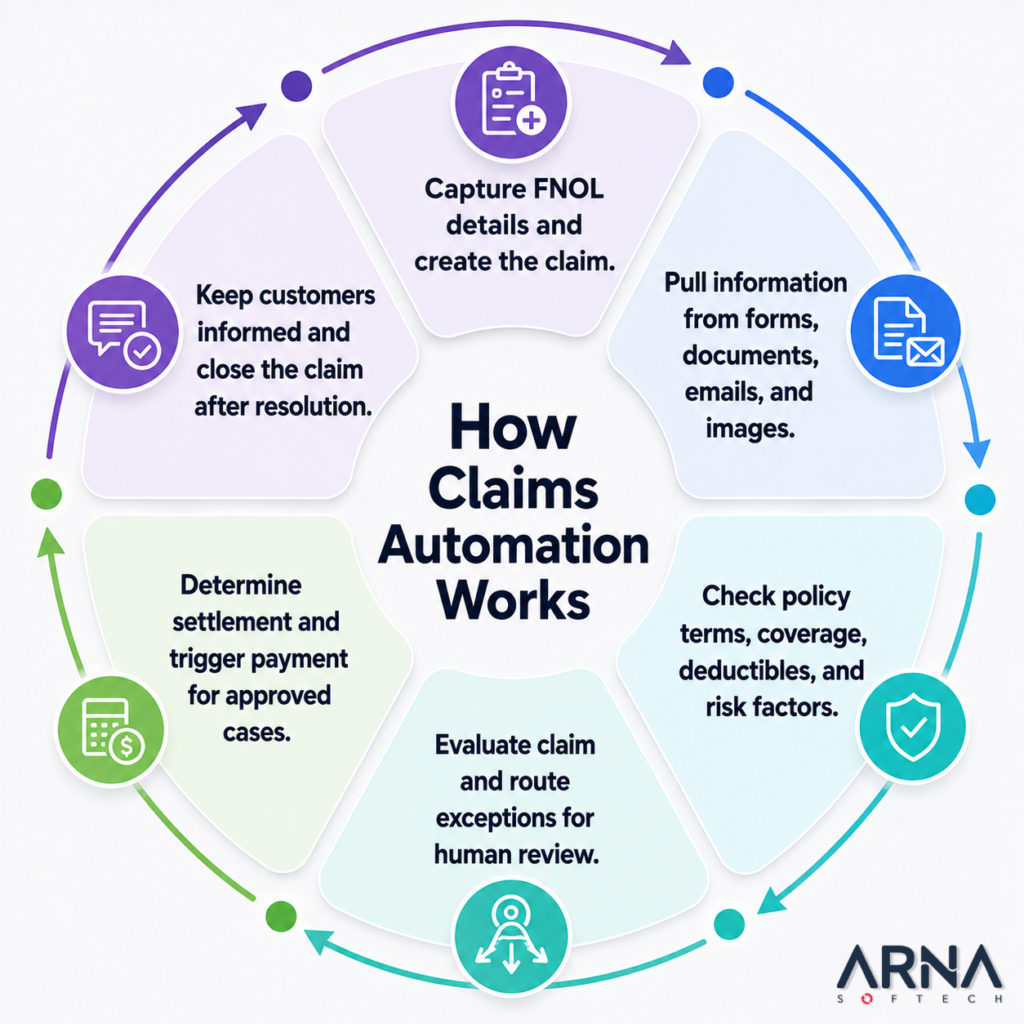
Website Blog - How Claims Automation Works

A well-designed workflow shortens processing cycles and gives teams better visibility into every case. The real advantage is having an operating model that can grow over time. Routine cases can move through the workflow with minimal intervention, while teams focus on complex issues and potential fraud.

What Features Should Claims Automation Software Include?

The real test of claims automation software is what happens when it meets the complexity of real operations. Can it process both structured and unstructured data? Can it connect with existing systems? Can it adapt to different processes and give teams visibility and control? These are the features that determine whether the solution actually improves operations.
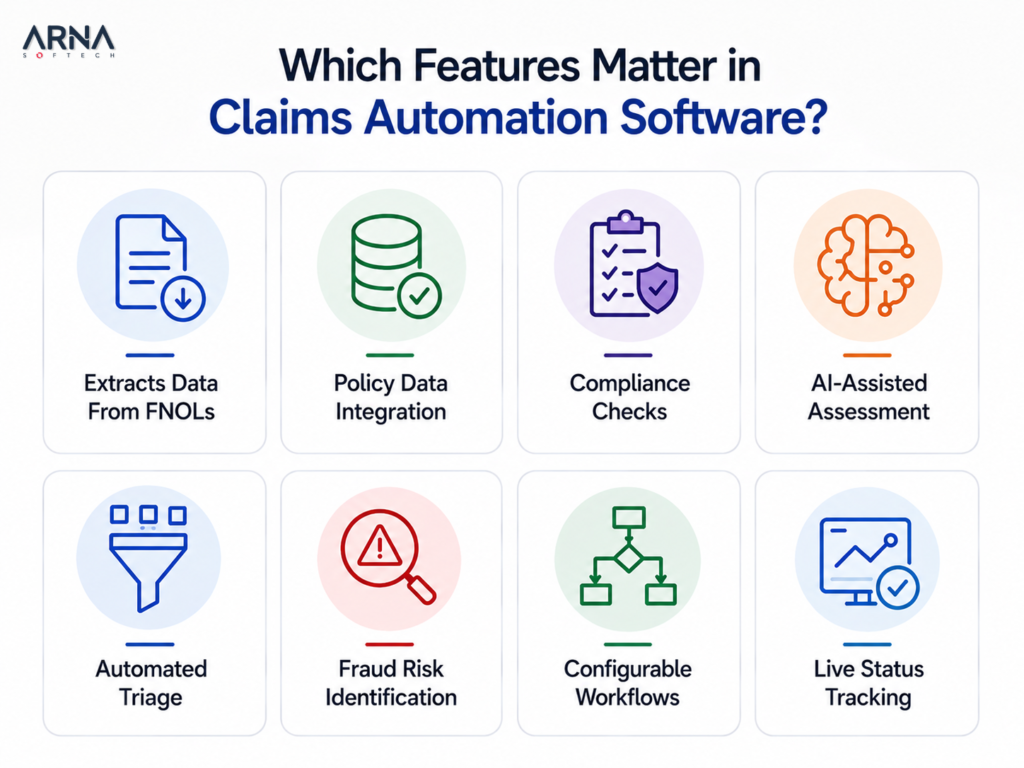

Website Blog - Which Features Matter in Claims Automation Software

A strong insurance application development strategy for automation should prioritize capabilities such as:

  • Intelligent Document Processing
    Extract and structure information from forms, PDFs, emails, images, and other documents.
  • System Integrations
    Connect with policy administration, CRM, payment, data, and other existing systems.
  • Compliance Controls
    Support regulatory checks, documentation requirements, approvals, and audit trails.
  • AI-Powered Decisions
    Use AI to identify patterns, assess information, and support decisions.
  • End-to-End Automation
    Flag potential fraud by detecting unusual patterns and inconsistencies.
  • Flexible Workflows
    Adapt rules, approvals, and processes to different products and business requirements.
  • Real-Time Tracking
    Provide up-to-date insight into claim status, workflow stages, exceptions, and outcomes.

Engineer Smarter Claims Operations with Arna Softech

We’ve built solutions that take on some of the most time-consuming work for insurers, from streamlining intake and routing to screening submissions for potential fraud.

One AI-powered application we built helped an insurance company automatically screen large volumes of incoming cases and flag those showing stronger fraud indicators, with the potential to prevent up to $260,000 in losses. For us, that’s what digital transformation in insurance is about. It should make day-to-day work simpler and more efficient.

Want to improve your claims process? Let’s discuss.

Frequently Asked Questions (FAQs)

How Can an Insurance Company Implement Robotic Process Automation in Claims?

Insurers can start with routine work like entering data, processing documents, and updating claims. From there, they can expand automation to other workflows.

Focus on one use case first. Use reliable data and keep human review in place. ML should support teams rather than make important decisions without review.

Automation can be applied across several insurance functions, from underwriting and policy administration to billing and customer service. Repetitive work with clear steps is usually the easiest to streamline.

Table of Content​
Get in touch

Looking to transform your legacy application with modern technologies? let us know how we can help you.

Subscribe to our newsletter

Get the latest updates on stream processing and tech insights.

Other Blogs
A no-fluff guide to building insurance apps that keep pace with what policyholders expect.
Software Development Company
employer branding
custom software development
digital transformation
ai driven, ai powered, custom software development, Custom software development company, digital transformation, employee engagement, employer brand award, employer branding, IT services, software development, Software Development Company, software development services, workplace culture
Reduce ongoing IT effort and create more room for portfolio growth with cloud.
Software Development Company
employer branding
custom software development
digital transformation
ai driven, ai powered, custom software development, Custom software development company, digital transformation, employee engagement, employer brand award, employer branding, IT services, software development, Software Development Company, software development services, workplace culture