Your 30-Second Summary
Whether you’re exploring the idea of a product engineering partner or already comparing options, this will help you approach the decision with more clarity. Instead of going over generic advice, this blog focuses on:
• What product engineering involves
• When it makes sense to bring in external support
• How to know if a team can really execute, not just impress on paper
Today, almost every business is under pressure to ship better products, faster. Whether it’s launching a new platform, modernising legacy systems, or embedding AI into existing workflows, the demand for product engineering solutions has gone from “nice to have” to mission-critical.
But here’s the catch. Having the right idea isn’t enough. Execution is everything, and that’s where your product engineering partner makes all the difference. Choosing a partner shouldn’t be just about comparing proposals or hourly rates. It’s about choosing a team you can rely on over time: one that understands how you think, how your product needs to grow, and how to build in a way that supports that growth.
It’s not “who can build this for us?” It’s “who can build this with us, and keep building as we scale?” This blog makes it easier to answer that clearly.
What Do Product Engineering Solutions Include?
A lot of companies think product engineering is just another way of saying “software development.” It’s not. Development is a part of it, but product engineering is the bigger picture. Here are the phases a product lifecycle typically includes:
1. Product Design Phase
• How should the product work?
• How will users interact with it?
• What problems is it solving?
• How will it hold up as it grows?
2. Product Development Phase
• Are we building what was actually discussed, or making assumptions?
• How are requirements being translated into features?
• How often are we reviewing what’s been built so far?
• How are changes or feedback being handled mid-build?
3. Product Testing Phase
• Does the product work in real-world scenarios?
• What happens when users behave unpredictably?
• Is performance consistent under pressure?
• Are we catching issues early or reacting too late?
4. Product Scaling and Maintenance Phase
• Will the product hold up as more users come in?
• How easy is it to fix, update, or improve things?
• Are we building something that’s easy to manage long-term?
• Is the product evolving, or just being patched over time?
That’s the key difference between basic development services and end-to-end product engineering solutions. Development focuses on delivering what is asked. Successful product engineering focuses on building something that lasts. Read this blog for a more in-depth understanding of the differences between these two approaches.
When Do You Need a Product Engineering Company?
Here are situations where a product engineering company makes sense:
• Building something from scratch – You have an idea (even validated), but no clear way to build it.
• Scaling an existing product – Things are working, but not smoothly. Growth is exposing gaps in performance, speed, or structure.
• Modernising legacy systems – Your current system “works,” but it’s slowing everything down and holding back new improvements.
There are also other quieter signs that you might feel in the day-to-day:
• Even simple features take longer to implement than expected.
• Things are getting built, then rebuilt, then adjusted again.
• Your team is busy fixing issues instead of moving forward.
• Requirements, priorities, and outcomes keep shifting midway.
• Everyone’s doing tasks, but nothing gets closed.
How to Pick the Right Product Engineering Solutions Company?
If you’ve started evaluating different software product engineering service providers, you’ve probably noticed how similar everything sounds on paper. Same tech stacks, same promises, same “we are the best” messaging.
Instead of looking at surface-level claims, here’s how we usually advise teams to evaluate a partner, based on what impacts outcomes. Sharing this from our own experience at Arna Softech, both as builders and as partners to growing product teams.
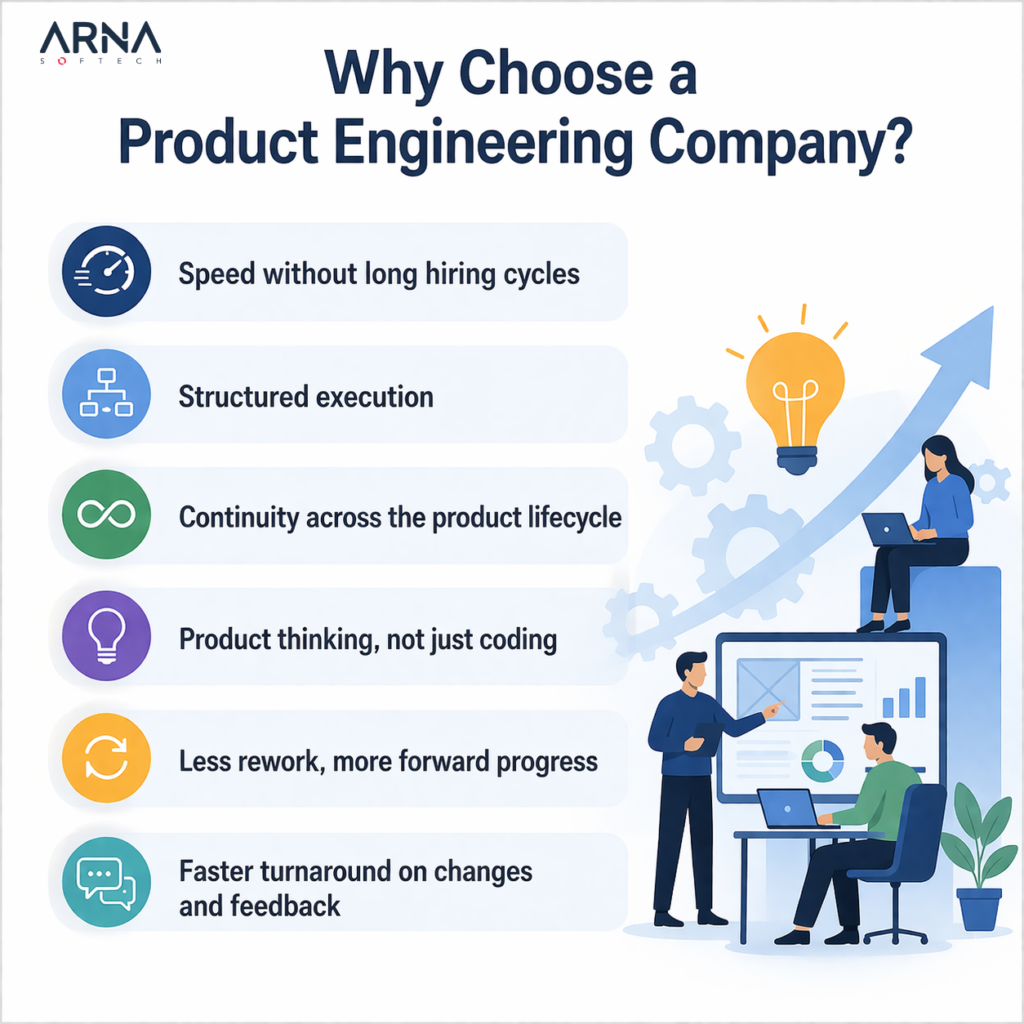
• Product Thinking, Not Just Task Execution
Anyone can execute a list of requirements. It’s important that they understand why those requirements exist. Do they ask questions about your users, your business model, and your constraints? Or do they just start building?
At Arna Softech, we spend a lot of time upfront aligning on outcomes. Because building the wrong thing efficiently is still the wrong outcome.
• Experience with End-to-End Product Building
There’s a big difference between contributing to a part of a system and owning a product journey from idea to scale.
Look for teams that have handled the full lifecycle:
• Design
• Development
• Testing
• Iteration
• Post-launch evolution
That experience shows in how they anticipate issues and guide decisions.
• Technical Expertise Is Practical, Not a Showy List
A long list of technologies means little without the right application.
What you want to understand is this: Can they choose the right tools for your product, not just the most popular ones? Can they adapt based on your needs?
We’ve seen projects slow down because teams forced a stack they were comfortable with. Our approach at Arna Softech is the opposite: we fit the tech to the product, not the other way around.
• Scalability and Long-Term Support
Building is one phase. Evolving is where most of the real work happens.
Can this team support you when your product grows in users, features, and complexity? Or will they struggle to support you as you scale? Continuity is what helps your product move forward without constant resets.
• Building Right the First Time
A major hidden cost in product development is rework.
If a team isn’t aligned early, you end up revisiting decisions, rebuilding features, and losing time. A good software product engineering services partner minimises this by asking the right questions upfront and validating along the way.
• Communication is Clear and Timely
You don’t need constant meetings. You need proper updates on what’s going on and what’s next, without following up again and again.
Simple, consistent communication helps things move faster and avoids confusion. That means clear updates, quick feedback loops, and minimal noise.
• Easy to Work With as a Team
This matters more than most people admit. You’re going to be working closely with this engineering team: through decisions, challenges, and pressure situations. If working together doesn’t feel natural, the end result will suffer.
Good partnerships feel like working with your own team. That’s always been our goal at Arna Softech: to integrate, not just deliver.
Final Thoughts
Choosing a software product engineering services partner shapes everything that follows, from early product thinking to how smoothly things move once development begins.
On the surface, most options will seem similar. The real difference shows up in the day-to-day work, as discussed above. The right partner makes progress feel steady. You’re not re-explaining requirements or dealing with constant back-and-forth. Things move forward with clarity, and your team isn’t pulled into unnecessary friction.
You can also explore one of our product engineering case studies to see how these factors come together in a real project setting.
What to Avoid When Selecting a Product Engineering Partner?
Focusing on cost over capability, skipping alignment, and choosing based on proposals instead of the actual working style.
How Can a Product Engineering Partner Fit Into Your Team Structure?
They can extend your team or take ownership of specific areas, based on where you need the most support.
How Can a Product Engineering Partner Improve Your Time to Market?
By reducing delays throughout, resulting in faster alignment, smoother execution, and less back-and-forth.