Moving to the cloud sounds exciting. But only until you have to decide how to get there.
Do you move what you already have? Or do you rebuild things to make the most of the cloud? That’s where the confusion begins.
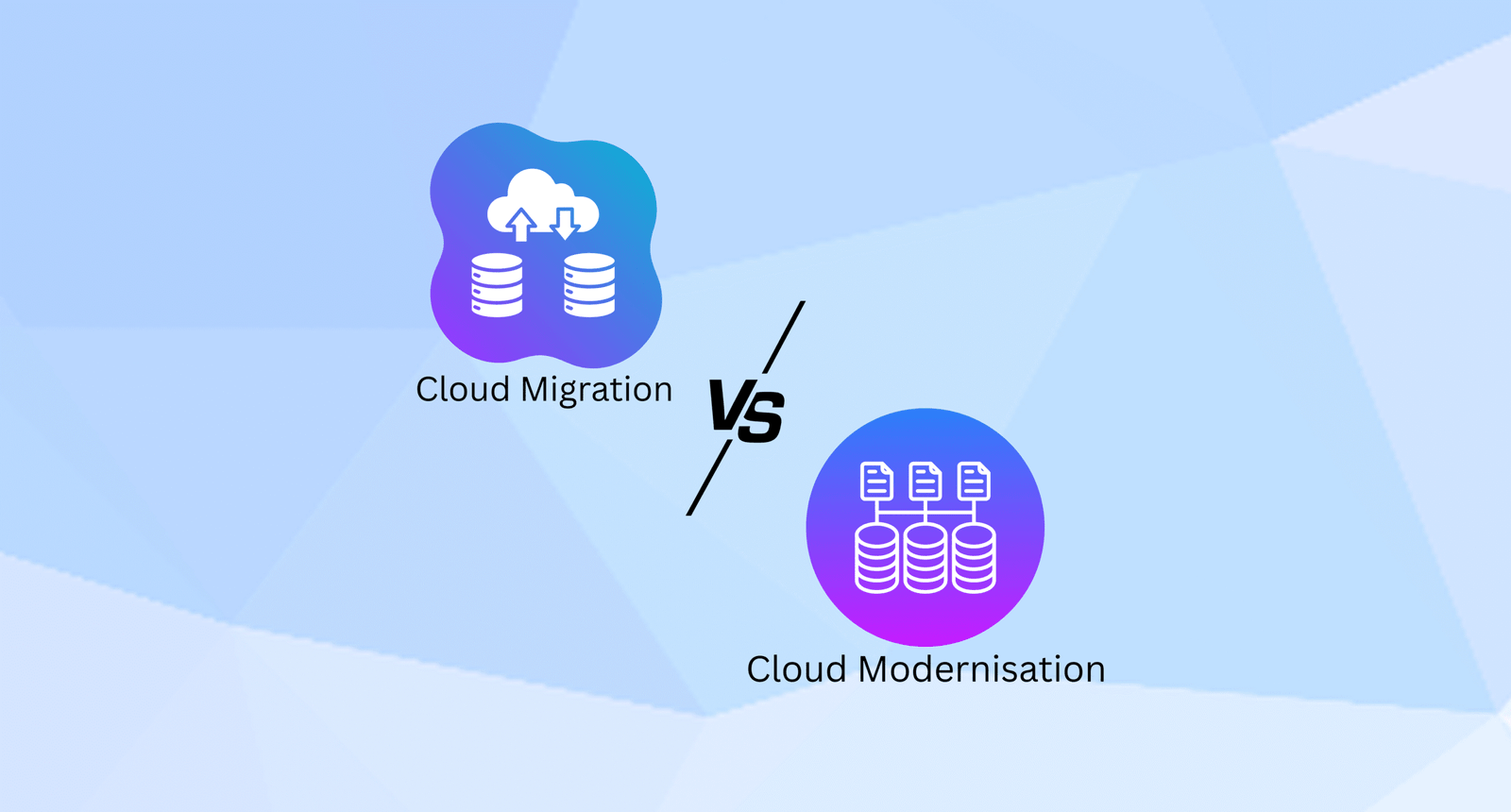
In this blog, we’ll talk about the two most common ways to move to the cloud: migration and modernisation.
You’ll learn what each one involves and how to figure out which is the best option for your business. So that when you’re ready for cloud engineering services, you go in with a precise picture of your organisational needs.
Before we start, though, if you are new to cloud and need a quick introduction, check out this blog on cloud basics.
Understanding the Two Cloud Approaches
First off, what’s the difference between the two?
Cloud migration is straightforward. You shift your systems (like your applications, data, and infrastructure) to the cloud. You don’t change how things work; you just change where they run.
Cloud modernisation takes a different approach. Instead of shifting systems as they are, you update how they’re built and managed. The goal is to make them cloud-native, meaning they’re designed to run smoothly on the cloud itself, with tools and technologies made for that environment.
There are pros and cons to both options, which is what we’ll be talking about next. It’ll show you what makes each kind of cloud engineering service unique.
Benefits & Challenges of Cloud Migration
1. Benefits of Cloud Migration
• A faster route than rebuilding completely.
• Your teams can keep working with minimal disruption.
• You save upfront costs by reusing what you already have.
• Teams can continue using familiar tools and workflows.
• You start seeing value from the cloud much sooner.
2. Challenges of Cloud Migration
• You don’t get to fully leverage cloud-native capabilities.
• Long-term costs can rise if systems aren’t optimised for the cloud.
• Older applications might not always run smoothly in the new setup.
• Security models may need rethinking to fit the cloud environment.
• Performance improvements may be limited without further optimisation.
Benefits & Challenges of Cloud Modernisation
1. Benefits of Cloud Modernisation
• Get faster, more efficient systems built to perform on the cloud.
• Take full advantage of modern cloud tools and services.
• Save more in the long run through optimised resource use.
• Systems become tougher and less prone to downtime.
• Systems are ready for new technologies like AI and analytics.
2. Challenges of Cloud Modernisation
• It takes more time, money, and planning than migration.
• The process can temporarily slow down ongoing operations.
• Integrating modern systems with older ones can get complex.
• Your team might need some training to work with new tools.
• The benefits build up slowly, so patience is important.
Finding the Best Fit for Your Business
Here are the top three factors you should keep in mind before hiring cloud strategy engineering services.
1. State of Your Current Systems
Take a look at how your systems are performing.
Are they running okay? Are they supporting your day-to-day operations properly? If performance is not a problem, and all you want is more scalability, cloud migration might be enough for you.
But, say your applications are using older technologies. The performance is not as per your expectations. And every time you want to update the application as per your current business needs, you know it’s not going to be easy. This is a situation where cloud modernisation is going to be a better fit for you.
2. Budget and Timelines
Cloud migration doesn’t require high expenses upfront and is usually faster too. If you’re not willing to dedicate too much time and budget right now for a cloud upgrade, go with migration.
Whereas modernisation demands more time and investment during the initial setup. But it offers benefits over time; your systems run better, cost less to maintain, and grow more easily.
On one hand, you should keep your current budget in mind; on the other hand, you should also think about the long-term value of your investment.
3. Your Business Goals
Look at the problems you want to solve and the priorities you want to focus on.
If they’re as simple as moving off ageing infrastructure or cutting costs, a migration is probably all you need. It wouldn’t make sense in this case for you to go through the deep architectural changes that come with modernisation.
You only need these extensive changes when you want to build something that’s more future- and growth-ready. Something that allows you to scale and adapt easily. Something that can be as agile as your business operations. Cloud modernisation is what will help you prepare for this.
A Real-World Cloud Journey
We’ve covered enough theory. Now, let’s see it in action. Here’s a client story about how we helped them move to the cloud with our Azure cloud engineering services.
Final Takeaway
So, migration or modernisation? Think in simple terms: where your business is now and what your future plans are. Once you’re clear on these, choosing the right path will get easier.
If you want help deciding the best approach for your business, you can leave your questions for us here. Whether it’s a simple migration or full-scale modernisation, our cloud engineering services will ensure your move to the cloud works for your business.