“Custom software” doesn’t have to mean building everything yourself.
In financial services, that approach can quickly become expensive, slow, and unnecessarily complex. The smarter approach to custom financial software development is to figure out which capabilities need to be tailored around your business and which are better handled by existing products or specialized systems.
That’s the approach we’ll explore in this blog. How do you work out which capabilities to build, integrate, or buy? And how do you do it without turning development into a massive, expensive project?
Custom Financial Software: Build Around Your Workflow
The core idea is to put your technology investment behind the parts of the business that differentiate you. Build there. Avoid turning standard capabilities into lengthy development projects.
The biggest mistake with financial application development is building the wrong things from the ground up.
If a process depends on your own business rules, approval logic, pricing model, risk approach, or customer experience, that’s where tailored software can make sense. You control how that part works, so the technology should reflect it.
Other capabilities don’t need the same treatment. If a specialized provider already solves a problem well, connect to it. If a capability is standard across the industry, an existing product may be enough.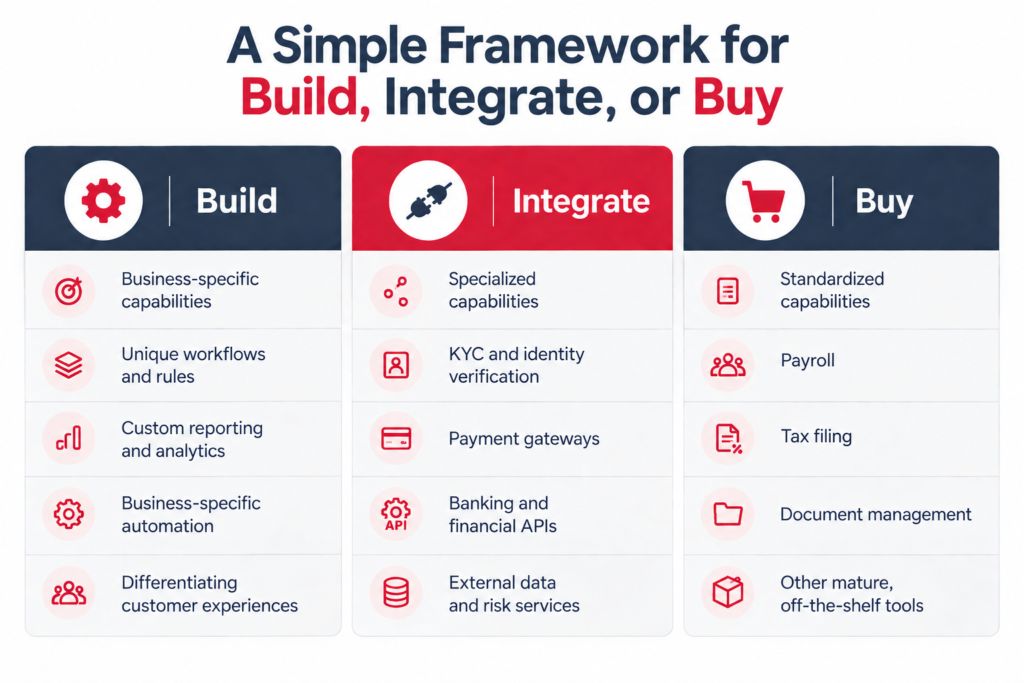
Types of Financial Software - Which Capabilities to Build, Integrate, or Buy
Financial software solutions cover very different needs, and that matters when deciding what to build, buy, or integrate.
1. Banking Software
Build – Core banking workflows, account management, transaction processing, custom reporting, analytics, and business-specific automation.
Integrate – KYC, identity verification, payment networks, and authentication services.
Buy – ATM and branch operations software where requirements are standard.
2. Payment Software
Build – Transaction routing, reconciliation, pricing rules, and payment workflows.
Integrate – Payment gateways, banking APIs, authentication, and risk services.
Buy – Merchant invoicing and receipt-generation tools.
3. Lending Software
Build – Loan origination workflows, eligibility rules, credit decisioning, approval logic, borrower journeys, and collections workflows.
Integrate – Credit bureaus, KYC, identity verification, e-signature services, and external data providers.
Buy – Loan document-generation tools.
4. Investment & Wealth Management Software
Build – Portfolio workflows, client experiences, investment rules, and processes that differentiate your offering.
Integrate – Market data, custodial platforms, external investment services, and identity verification.
Buy – Client communication and document-generation tools.
5. Accounting & Financial Management Software
Build – Financial processes, approval processes, reconciliation rules, reporting, analytics, and business-specific automation.
Integrate – Banking systems, payment platforms, ERP systems, tax services, and external data sources.
Buy – Payroll, tax filing, and statutory compliance software.
What Does Custom Financial Software Development Involve?
This is where fintech custom software development can either become a focused project or turn into a much bigger one than expected. Here’s what you need to get right at each step.
1. Requirements
Start with the process. What are you trying to improve? Where do decisions happen? What rules and exceptions need to be supported?
2. Architecture
Work out where the new solution fits into your existing technology. This is also where you plan for future users, transactions, data, and integrations.
3. Integrations
Identify what needs to connect. KYC providers, payment gateways, banking systems, credit bureaus, ERP platforms, and more may all be part of the picture.
4. Development
Build the capabilities that are specific to your workflow, including automation, reporting, and business rules.
5. Testing
Validate the software against real-world financial scenarios, not just ideal ones.
6. Deployment & Maintenance
Launch and improve the system as requirements change.
And throughout all of this, security, compliance, and scalability need to be built into the thinking from the beginning.
Conclusion
Financial software development works best when you build around the parts of your business that genuinely need to be yours. Start with the workflow, decide where bespoke development adds real value, and use existing technology where it doesn’t. That keeps the solution focused and reduces unnecessary development, giving you more room to scale as the business evolves.
Planning a fintech software project? Let’s work out the right development approach.
Frequently Asked Questions (FAQs)
How Much Does It Cost to Develop a Bespoke Financial Application?
Two financial applications can have a similar number of features and still cost very different amounts to build. The difference comes down to the complexity of the workflows, integrations, data, security, and scale. Defining the custom part clearly upfront can save unnecessary development later.
What Should I Look for When Choosing a Financial Software Development Partner?
Look for experience across the full project journey. From understanding your business and designing the solution to integrations, testing, and deployment. You want a partner who can think through the business problem, not simply execute a feature list.
What are the Best Practices for Securing Financial Data in New Software?
Security should be built into the software from day one. A few essentials include:
- Encrypt critical financial data.
- Give users access only to the data they need.
- Secure APIs and third-party integrations.
- Keep clear records of important system activity.
- Monitor unusual access and transaction activity.