Insurance companies run on data. Every policy issued and every claim processed – it all generates information. But that data is often spread across many systems. Bringing it all together is one of the biggest data challenges insurers face today. Cloud-based data integration solves this challenge. It creates a connected environment where information can move freely across systems and teams.
What builds this connected ecosystem is data engineering services and solutions. The foundation that keeps your insurance data accessible and connected across the cloud.
Your Insurance Company Can't Ignore Cloud Data Integration. Here’s Why
An AI consultant first maps out how a marketing agency currently operates, where the repetitive tasks are and where manual work is eating up time. Then they build solutions to automate that work and get processes moving smoothly.
1. One Trusted View of Your Policy and Claims Data
Policy, claims, and billing data often reside in separate systems, making it difficult to maintain a consistent view of data. Cloud data integration brings it all into one foundation. So, your underwriters, claims teams, and actuaries are always working from the same numbers.
2. Insurance Data Stops Being a Storage Problem
Insurance data keeps growing year after year. Cloud integration paired with scalable storage means you’re not re-architecting your infrastructure every time data grows. Behind the scenes a big data engineer helps make that scalability possible.
3. Underwriting, Claims, and Finance Work in Sync
With your underwriting, claims, and finance teams pulling from the same integrated data layer, alignment happens faster. Less time arguing over which loss ratio report is correct and more time acting on it.
4. Compliance Reporting Becomes Less Painful
Insurance operates in a highly regulated environment. When your data is integrated, pulling accurate reports across markets becomes simple. No more last-minute struggle before a regulatory deadline.
5. Better Data Means Better Risk Decisions
Your claims history, third-party risk feeds, and market data all connect in one place. This allows your underwriters to price risk more accurately and spot new risks before they become costly.
See this case study on how we helped an insurance provider bring all its data together for better reporting and analytics.
How Do Data Engineering Services and Solutions Enable Insurance Data Integration?
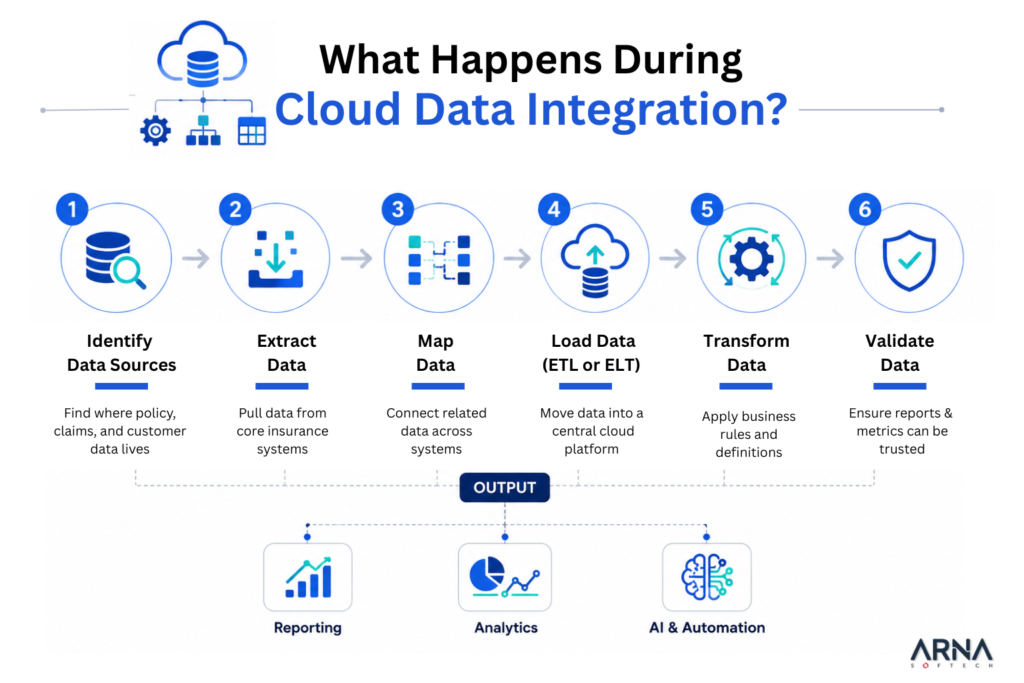
1. Identify and Assess Data Sources
Map out your policy systems, claims platforms, and any legacy tools still in play. What each holds, how often it updates, and how it ties into the bigger picture.
2. Extract Data From Source Systems
Once your sources are mapped, data is pulled using APIs, connectors, or batch processes. Some insurers need real-time claims feeds. Others are fine with scheduled overnight syncs.
3. Map Data Across Systems
This is where you connect the dots. A policyholder ID in your CRM and a claimant number in your claims system might refer to the same person. Data mapping makes sure those relationships are clearly defined.
4. Map Data Across Systems
Now, data is loaded into a central cloud platform where your underwriters, claims teams, and actuaries can access and act on it. Big data engineers often consider two approaches here:
1. Extract, Transform, Load – Refines raw data before loading it for use. Good for regulatory reporting where accuracy matters a lot.
2. Extract, Load, Transform – Imports raw data first and refines it later. Better for high-volume environments. Ideal for claims analytics, where timely insights matter.
5. Map Data Across Systems
By this point your data is in one place, but it’s still raw. Transformation is where you clean it up and make it usable. Think aligning claim codes and standardising policy statuses. Once done, your teams are working with data that actually makes sense.
6. Validate Data and Maintain Quality Standards
Before data reaches any dashboard or report, it needs a quality check. Are the claim figures matching the source system? Are policy records complete? Catching issues here prevents bad data from driving bad decisions.
Related reading: Looking beyond data integration? Explore the fundamentals of product engineering in our Product Engineering Guide.
Final Takeaways
Most insurance businesses deal with huge volumes of data across multiple systems and under strict regulatory requirements. Arna Softech specialises in cloud-based data integration for exactly these environments. We know what it takes to move large, complex datasets reliably. We do it without overlooking quality or governance. If that’s the kind of insurance environment you’re working in, let’s talk. Book a data engineering consultation Now!
Frequently Asked Questions (FAQs)
What is Cloud Data Integration for Insurance?
It means connecting your policy systems, claims platforms, and business tools into a single cloud environment, so your data works together seamlessly.
What is the Best Cloud Data Integration Tool?
Many enterprises choose Azure Data Factory because it lets them manage their data workflows from a single Microsoft platform.
How to Choose a Cloud Data Integration Service Provider for Insurance Companies?
Look for a team that understands both data engineering and the insurance business. They should know their way around core insurance systems and have hands-on experience with leading cloud platforms.