Insurance application development can make a noticeable difference in the places where insurers lose the most time. Manual data entry, repeated checks, disconnected systems, and processes that still rely on people moving information around.
Modern applications can take repetitive work off teams’ hands, making it easier to handle more business without adding to the workload.
This guide breaks down the features that make insurance applications work the way underwriters, claims teams, and policyholders need, along with a practical roadmap for building the applications right.
A Look at Different Types of Insurance Applications
The most common types of insurance application development include:
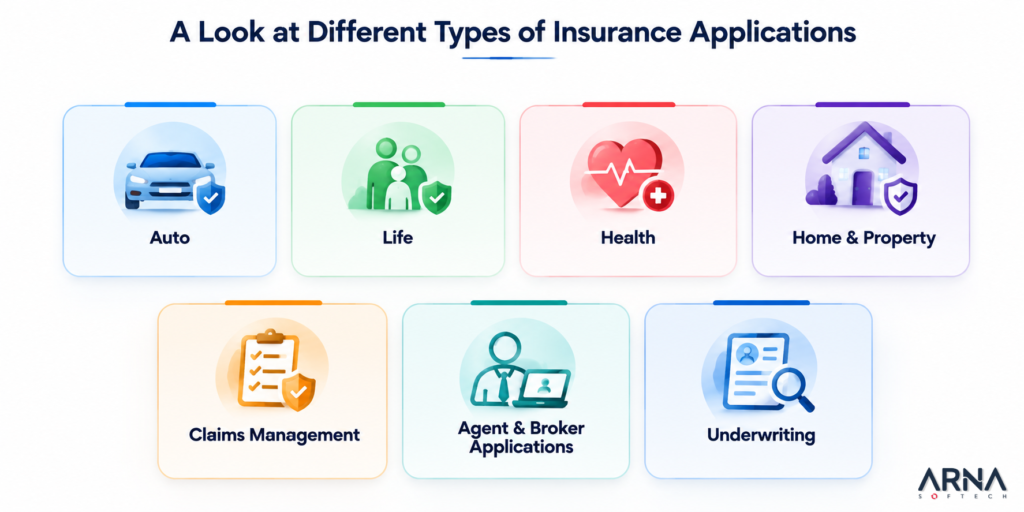
- Auto
Supports the full journey from getting a quote and buying coverage to reporting accidents and managing claims. - Life
Makes it easier to manage life policies, premiums, beneficiaries, documents, and servicing requests. - Health
Helps customers manage coverage, access benefits, find providers, and handle health-related claims and documents. - Home & Property
Helps policyholders manage property coverage, report damage, submit claims, and access policy information. - Claims Management Applications
Brings key claims activities together, from the first notice of loss and document collection to investigation and settlement. - Agent & Broker Applications
Keeps key customer and sales information in one place, from profiles and quotes to policies and documents. - Underwriting Applications
Gives underwriters easy access to the information they need. They can assess risk and make policy decisions without switching between different sources.
What Features Should Your Insurance App Have?
At a minimum, modern app development for insurance should consider the following:
1. Customer & Policy Dashboard
A single dashboard can bring policies, coverage details, premiums, and documents together. Customers can quickly find what they need without checking different places. For internal teams, the same principle can provide a consolidated view of customer and policy data.
2. Quote & Application Management
A modern application should make it easy to collect applicant information, generate quotes, and move an application toward issuance. Pre-filled data, automatic validation, and external data integrations can cut down on repetitive entry and help speed up quoting. For agents and brokers, this can mean less time spent switching between systems.
3. Claims Management
Users should be able to report a loss, upload photos and documents, provide additional information, and track progress without repeatedly contacting the insurer.
On the insurer’s side, workflow automation can help route claims, trigger next steps, and keep adjusters working from the same information. This is where automated insurance claims processing becomes valuable, as it improves consistency in how claims are resolved.
4. AI-Powered Assistance
AI can handle many of the questions and routine interactions that otherwise reach customer service teams. An AI assistant can help users understand policy information, find documents, or check claim status. For insurers, this creates an opportunity to improve response times without requiring teams to manually handle every interaction.
5. Role-Based Access
An agent may need access to policy details, while an underwriter may need risk and application data. Role-based access keeps these permissions specific to each role and helps protect sensitive information
6. Secure Payment Processing
Premium collection should be convenient for customers while remaining secure and easy for insurers to manage. Applications can support one-time payments, recurring billing, saved payment methods, receipts, and payment history.
7. Document Management
Insurance documents are spread across many processes. From applications and policies to claims and renewals. Bringing them into one secure place makes documents easier to find, manage, and share. Integrating document management with relevant workflows can also reduce the need for manual document collection and tracking.
Key Development Steps for Insurance Applications
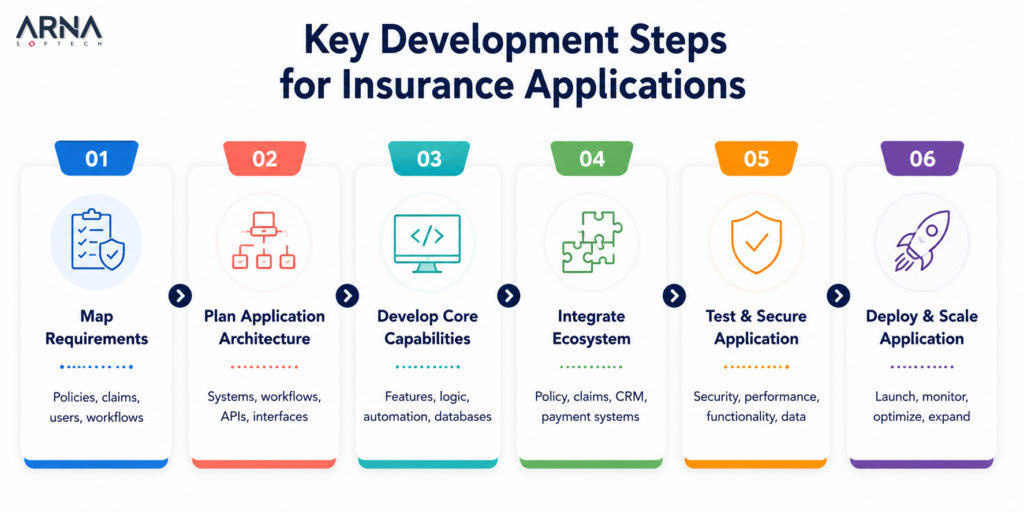
First, the application’s scope and technical requirements are defined. The next steps cover architecture and UX design, application development, and integration with the systems already in place. Security and performance are then validated before deployment. Once live, the application can be monitored and continuously improved.
What Deserves Extra Attention During App Development?
- Automate Where It Creates Value – Automation in insurance can take care of repetitive, high-volume tasks without taking human judgment out of important decisions.
- Make Exceptions Easy to Handle – Not every case will follow the standard path. Applications should make it easy to spot unusual cases, send them to the right person, and keep things moving.
- Keep Auditability Built In – From approvals to policy changes, important actions need to be easy to track. The application should record them automatically as part of the workflow.
Build Your Insurance App With Arna Softech
Insurance is one of the sectors we’ve worked across extensively, with applications spanning underwriting, claims, policy operations, fraud detection, and data management.
We understand digital transformation in insurance needs to improve the way work is already done. That means supporting human decisions and connecting new technology with existing systems.
It helps to have a partner who understands both the technology and the realities of insurance. Have a project in mind? Let’s talk.
Frequently Asked Questions (FAQs)
How to Choose a Vendor for Insurance Application Development Services?
Consider a partner that has real experience building for insurers. Look at what they’ve built before, how well they understand insurance, and how easily they can connect with your existing systems.
How Much Does It Cost to Develop an Insurance Application?
There is no fixed cost. A basic application may cost $30,000–$75,000. A complex platform with multiple workflows, integrations, automation, and advanced security can exceed $250,000.
Explain the Benefits of Cloud-Native Architecture for Insurance Applications.
Cloud-native architecture gives applications room to grow. It supports high transaction volumes, faster feature releases, system resilience, and easier integration, helping insurers modernize while keeping the technology environment flexible.