
Your 30-Second Summary
RFQs are a normal part of how businesses buy things. Most teams still run them manually out of habit. But manual RFQs aren’t built for high volume and fast turnaround. This gap offers the perfect opportunity for automation with AI agents to make the process more seamless.
What’s coming up:
• RFQ meaning in simple terms
• Manual RFQ challenges that hurt speed and accuracy
• What gets easier once RFQs are automated (plus a real client story)
If RFQs are part of your business operations, you know how easily things slow down when supplier details are spread across emails, chats, and attachments. And when it’s time to compare quotes and select a vendor, you’re still piecing together what’s final and what’s missing.
If that sounds familiar, this blog will show you what a better RFQ workflow can look like.
We’ll explain the RFQ process meaning, why the manual approach becomes inefficient as volumes grow, and what changes when you automate the process.
What is the RFQ Process?
At some point, every growing business runs into this situation:
You need a product or service, you have multiple vendors who could deliver it, and you want to make sure you’re getting the best value and not just the lowest price.
That’s where the RFQ process comes in.
A Request for Quotation is a process businesses use to collect pricing and commercial details from different vendors for the same requirement. It helps them understand what each of these suppliers is offering before making a purchase decision.
RFQs help you compare vendor options, so you can decide based on facts rather than instinct. These facts include pricing, timelines, terms and conditions, etc. Once you have your evaluation criteria on hand, you can decide which option is ideal.
What Makes Manual RFQ Management Challenging?
Managing RFQs using emails, spreadsheets, shared folders, and follow-ups can work when volumes are low. But when vendors, requests, and stakeholders increase, things become problematic.
• Too Many Moving Conversations
One RFQ can easily mean dozens of emails. It usually starts with sending the RFQ to multiple suppliers over email. Then vendors come back with questions and updated quotes. Before you know it, key details are buried somewhere in the inbox. Figuring out what’s final and what’s outdated becomes a task in itself.
• Inconsistent and Non-Comparable Quotes
Vendors may respond in different formats, currencies, and structures. Some might include all the details, while others might miss key information. Comparing quotes is no longer simple because you have to first make sense of all the inconsistent information you’ve received.
• Not Scalable as the Business Grows
When RFQ volume increases, the manual process quickly becomes too much to manage. You’re suddenly juggling multiple documents, follow-ups, and approvals all at once. Choosing the best option becomes secondary. You’re more worried about keeping the process from falling apart.
Automating RFQs: The Smart Move
If manual RFQs have become a roadblock in your business, consider introducing automation to your process. It will bring structure to the workflows and reduce the busywork. Here’s how.
• Sending RFQs Becomes Quick and Consistent
Creating and sharing RFQs gets a lot easier. Instead of rewriting the RFQ for each supplier, you create it once and send it out in one shot. Every supplier receives the same clear request. There’s no more double-checking every email for the right document and version.
• Stop Errors Before They Start
One big problem with manual RFQs is the amount of copying and pasting involved across emails and spreadsheets. Making mistakes like entering the wrong number or forgetting to fill in a certain field becomes more likely. Automation helps do away with all the copy-paste work, helping maintain better accuracy.
• Supplier Responses Become Easier to Work With
RFQ automation allows vendors to respond through a structured system; their inputs follow the same format. It saves you from cleaning up inconsistent quotes just to compare them. Your team can focus on picking the right option, not fixing formats.
• Faster and Simpler Vendor Selection
Imagine comparing hundreds of bids manually and trying to figure out the optimal one. This is tedious and also leads to underconfident decisions. Automated RFQs make comparisons more straightforward and let you choose the best vendor with more clarity.
How to Automate the RFQ Process?
The best way to understand RFQ automation is to see it in action. So let’s look at a real client example. Here’s a story of how we helped a client automate their RFQ process and achieve a far more manageable system.
What Was Happening Before
• Procurement teams had to manually copy the RFQ line items from emails to spreadsheets.
• Supplier data wasn’t in one place. Past suppliers were in Airtable; new ones were tracked elsewhere.
• There was no easy way to benchmark current quotes against historical pricing.
• Drafting emails and tracking responses and quote statuses were manual and time-consuming.
What We Automated
Instead of fixing only one part of the workflow, we automated the full cycle using n8n, Google Gemini, Airtable, and Google Sheets, with Gmail as the communication layer.
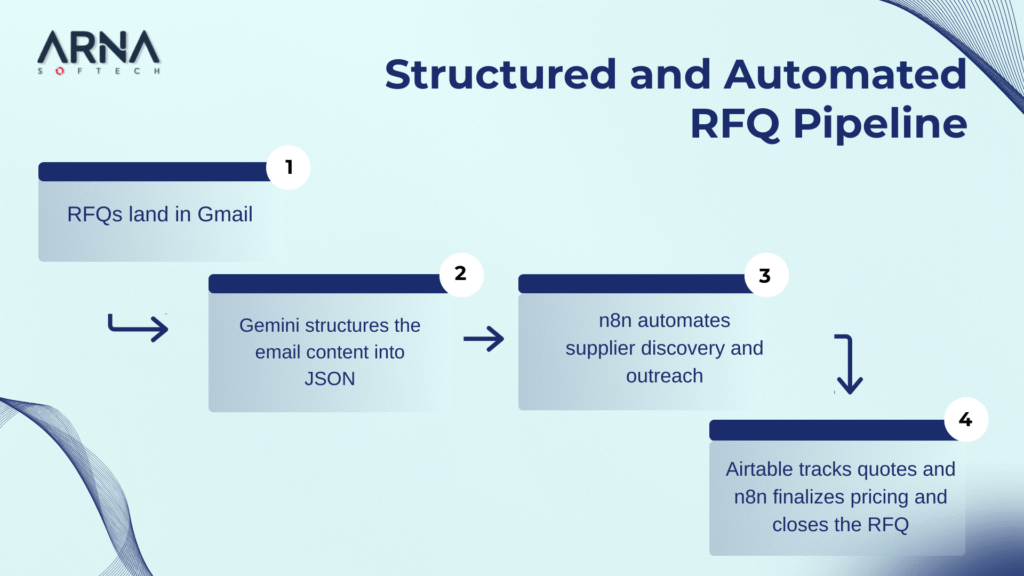
Here’s what that looked like:
• RFQs from customers were detected from incoming emails.
• Product details were auto-extracted (no more manual entry).
• Suppliers were identified using past data as well as AI suggestions.
• RFQ emails to suppliers were drafted automatically and sent consistently.
• Supplier quotes were captured and structured automatically.
• The system compared costs and created the final customer quote draft.
What Improved After Automating RFQs
Here’s the impact the client saw after moving to an automated RFQ process.
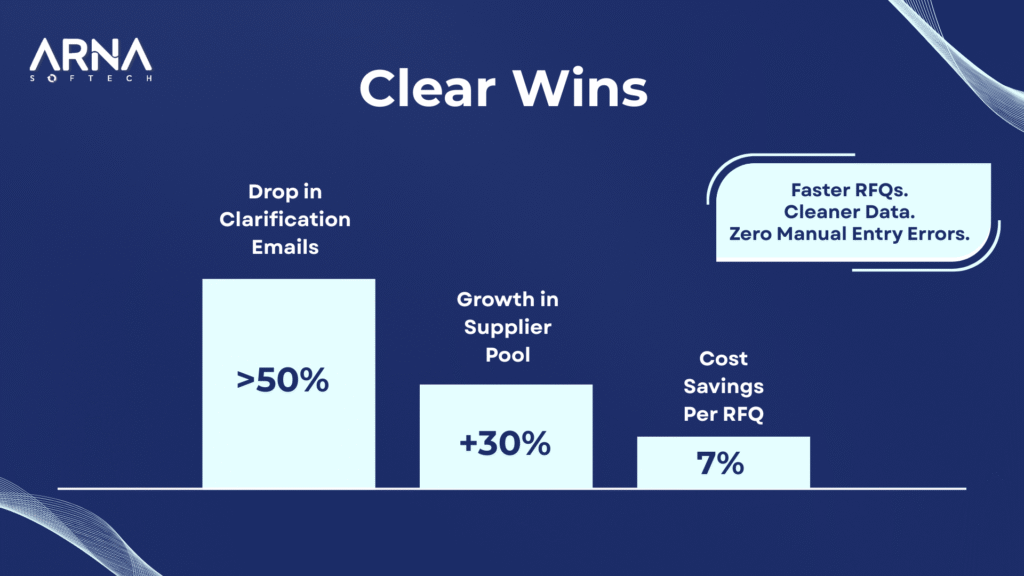
Your Next Shift: RFQ Automation
At the end of the day, RFQs are meant to help you buy better and faster. But when the workflow is manual, most of the time goes into admin work. RFQ automation changes that completely. Even as RFQ volumes grow, the process remains organised and trackable.
Ready to stop following up on quotes and start closing RFQs in less time? Let’s talk.
What is the RFQ Workflow?
An RFQ workflow includes sending a formal request to suppliers regarding a product/service (asking details like pricing and payment terms), collecting supplier quotes, comparing options, and picking the most apt one to place the purchase order with.
What are Common RFQ Mistakes?
Common RFQ mistakes consist of unclear requirements, sending incomplete RFQs, comparing quotes that aren’t for the same scope, relying only on the lowest price, missing follow-ups, and losing track of versions or approvals.
What’s the Difference Between RFQ and RFP?
A Request for Quotation is used when you know what you need and mainly want to compare prices and terms. A Request for Proposal is useful when you want vendors to suggest the best approach, along with pricing.