Your 30-Second Summary
This blog looks at cloud migration from a data perspective. Because data carries dependencies, context, and risks that don’t move neatly. Inside this guide, you’ll learn:
• Product development lifecycle (PDLC) meaning
• What are the core stages of PDLC
• A simple overview of goals, actions, & outcomes for each stage
Every digital product you use today, whether it’s a web application, a mobile app, or a SaaS platform, didn’t just appear out of nowhere. It went through a series of decisions, iterations, failures, and refinements before it reached you. That journey is known as the product development lifecycle.
At a simple level, product development is about turning an idea into a usable, market-ready solution. Now, having a great idea is rarely the problem. The challenge is executing it well. A well-defined product plan gives you direction on:
• Aligning teams
• Validating the idea early
• Prioritising the right features
• Making sure you’re building based on actual user needs
A recent report by CB Insights shows just how much this matters. It highlights the key reasons startups fail to take off. 43% of the companies studied failed simply because they didn’t find the right product–market fit. This suggests they may not have properly validated the product idea early on.
That’s where product engineering services prove their value. They ensure every step, from idea to launch, is structured. The cost of not having that structure is very real.
In this blog, we’ll take you through this lifecycle so you can build something that works now and can grow later.
What is Product Development Lifecycle (PDLC)?
Think of PDLC as the structure behind how good digital products get built. It’s the process of bringing a product to life, starting with an idea and continuing through launch and ongoing improvements. It’s not limited to development alone. It covers activities that happen before and after writing code as well.
Breaking Down the Product Development Lifecycle
Rather than a rigid process, PDLC is a flow where each stage answers a key question before you move ahead. Let’s go through all the product development life cycle stages one by one.
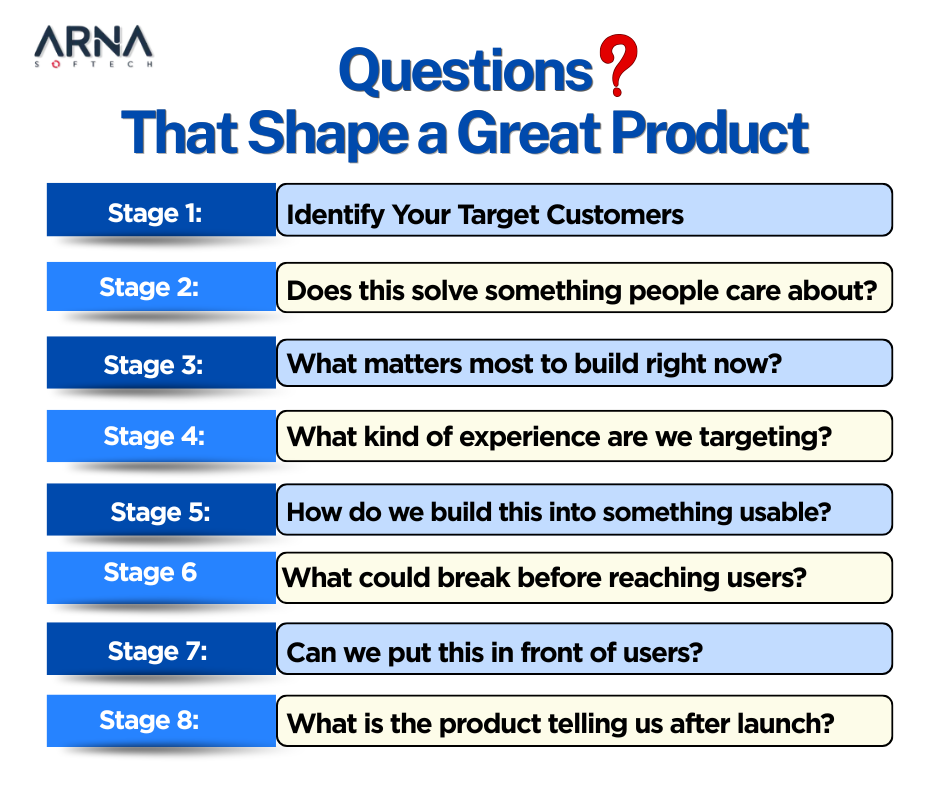
Stage 1 - Problem Identification
Goal: Turning ideas into clear problems worth solving.
What happens here:
• Identifying user pain points
• Understanding the target audience
• Looking at existing solutions in the market
• Framing the problem precisely (not the solution)
Outcome: A properly formulated problem statement with enough context to explore further.
Stage 2 - Research & Validation
Goal: Testing assumptions before investing heavily in building.
What happens here:
• User interviews and feedback collection
• Market and competitor analysis
• Checking early versions using wireframes, prototypes, or user feedback
• Validating demand and willingness to use/pay
Outcome: Checking whether the idea has potential or needs to be dropped.
Stage 3 - Planning & Strategy
Goal: Bringing structure to execution so teams aren’t building blindly.
What happens here:
• Defining product vision and goals (This real-world case study shows how a product idea can be thoughtfully shaped and differentiated from similar offerings)
• Prioritising features (what goes in, what doesn’t)
• Creating a roadmap and timelines
• Aligning teams on scope and expectations
Outcome: A plan that defines what to build first rather than listing features.
Stage 4 – Product Design (UX/UI)
Goal: Creating a quality product experience for the users.
What happens here:
• Mapping out how users move through the product
• Creating basic layouts and early versions of the design
• Designing how the product looks and feels (UI)
• Testing usability of the product early
Outcome: A user experience that feels natural without needing explanation.
Stage 5 – Development
Goal: Building the product such that it’s stable and scalable.
What happens here:
• Frontend and backend development
• Integrations and APIs
• Continuous development in short sprint cycles
• Internal testing alongside development
Outcome: A usable product version ready for testing.
Stage 6 - Quality Assurance
Goal: Catching issues before users do.
What happens here:
• Make sure features are working correctly
• Test performance and scalability
• Check usability and ease of use
• Fix issues and improve the product
Outcome: A stable product that can be put to real use.
Stage 7 – Launch
Goal: Getting the product into users’ hands in a controlled and thoughtful way.
What happens here:
• Deployment to production
• Release planning (soft launch, beta, full release)
• Monitoring initial user behavior
• Handling early feedback and issues
Outcome: A live product with real users and the first layer of real-world insights.
Stage 8 - Post-Launch & Updates
Goal: Evolving the product based on how people use it, not how you expected them to.
What happens here:
• Observing how users navigate the product
• Gathering feedback and identifying gaps
• Releasing updates and improvements
• Iterating on features and experience
Outcome: A product that keeps getting better and stays relevant over time.
To Sum It Up
Within the product lifecycle, each stage exists for a reason. It makes sure you don’t skip the thinking upfront and pay for it later.
If you’re looking for a product engineering company that can help you approach the software product development process with the right structure and mindset, Arna Softech can support you at every stage of the journey. We bring structure across the journey, so every stage builds seamlessly on the last.
Frequently Asked Questions (FAQs)
What's the Difference Between PLC and SDLC?
The Product Lifecycle looks at how a product lives and grows in the market. From the time it’s introduced to how it performs over time. The Software Development Lifecycle (SDLC) is much more focused on the execution. It deals specifically with how the software is built.
How Long Does Product Development Take?
For a basic MVP, timelines can vary from a few weeks to months. More complex products can take several months or longer.
The key thing to remember: product development doesn’t really “end” at launch. Improvements and updates are part of the lifecycle. Choosing a product engineering partner becomes an important decision here. Good collaboration leads to better speed and quality.
How to Integrate Quality Assurance in the Product Lifecycle?
QA becomes effective when it runs alongside development. It should begin right at the start, with validating the ideas. As the development continues, you should keep testing the parts being built. After the usual testing processes before launch, pay attention to how users are responding after the launch. Use that feedback to fine-tune the product.