Your 30-Second Summary
Here’s the new rule for building B2B products: rigid products break, and adaptable ones win. This blog walks you through how adaptability and smart product engineering keep your product future-proof.
Get ready to:
• Understand why adaptability has become so important for modern B2B products.
• Spot whether your product is currently rigid or flexible.
• Learn a clear 5-step framework to shift from rigidity to agility.
Here’s something B2B companies must realise – building a product is not enough.
You may start with a unique product. But as soon as it enters the market or gains any momentum, the industry is already witnessing the next big change.
When the business environment is so unpredictable, how you survive depends on product engineering services, specifically in designing products that can adapt to changing market dynamics. Because the more flexible your products are, the more easily your business can grow.
And if you still think stability is more important than change, you’re about to see the other side.
The Adaptability Check: Quick Test for Business Leaders
Let’s start with a quick check to see where your product engineering stands currently. Is it too rigid to change along with the market? Or is it adaptable enough to navigate through the ups and downs?
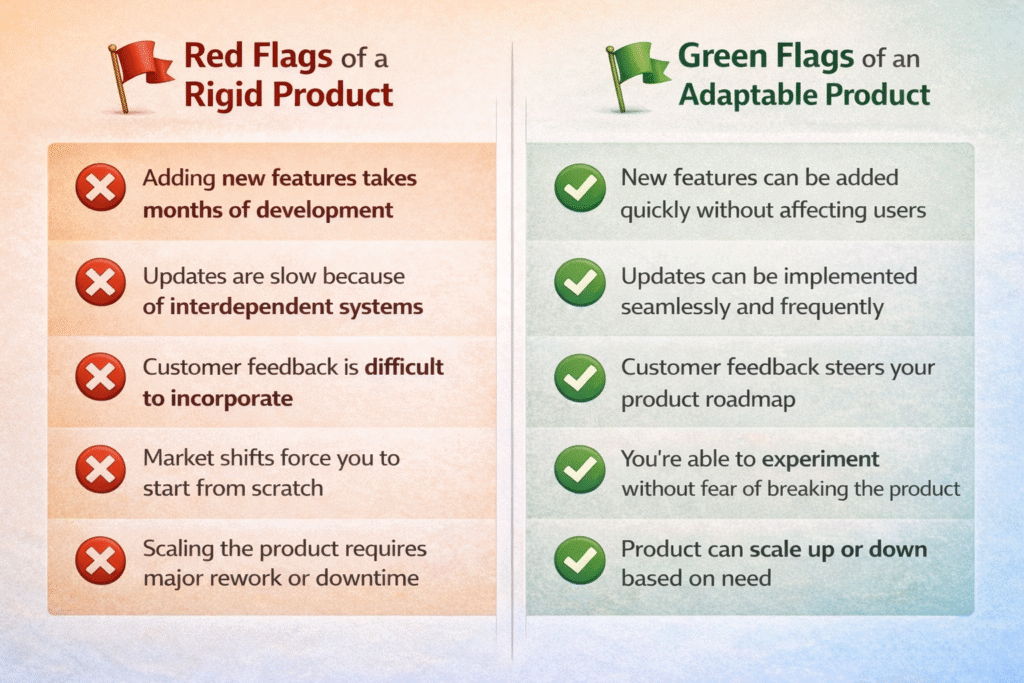
So, which side does your product fall into: rigid or adaptable?
If it’s already on the adaptable side, great! You’re set up for innovating and facing any market challenges head-on.
But if it’s leaning toward the rigid side, don’t panic. Do take it seriously, though. It’s high time for you to shift gears and work on making your product more flexible with product development company.
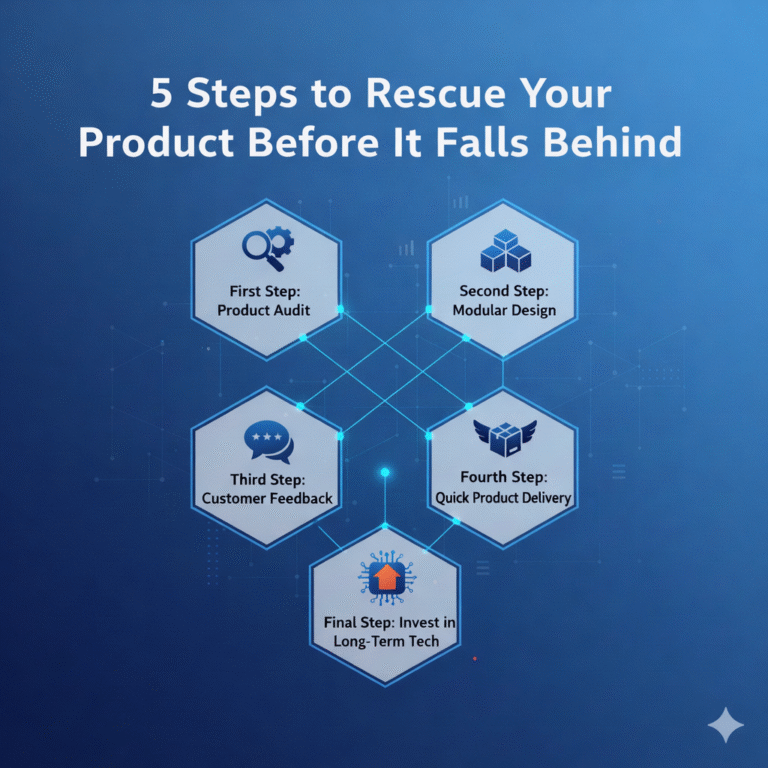
5 Steps to Rescue Your Product Before It Falls Behind
If you’re dealing with products that resist change, you need this action plan to make them more dynamic.
• First Step: Product Audit
• Second Step: Modular Design
• Third Step: Customer Feedback
• Fourth Step: Quick Product Delivery
• Final Step: Invest in Long-Term Tech
1. First Step: Product Audit
• List all core features of your product and identify which ones are hardest to change or update. Check which features could be made independent to allow faster iteration.
• Review past product changes: which were smooth and which caused delays or issues?
• Check areas that need modernisation. Consider updating any outdated code, dependencies, or legacy systems.
• Have regular discussions with your development, product, and customer success teams. They can help you understand the usual problem areas.
• Begin with the changes that will have the most impact on aspects like customer experience, product performance, or revenue.
2. Second Step: Modular Design
• See if you can break down complex features into smaller parts. This will help you manage each part separately without affecting the rest of the product.
• The modules should have well-defined interfaces. They should be able to interact with each other without any tight dependencies.
• A good way to save time on development and updates is to implement reusability. Create components that can be used for multiple features.
• Keep the core logic (the primary features) of your product separate from the add-ons (the secondary features). That way, your essential functionality stays stable as you continue working on the extra features.
• Your new modular design should account for any future integrations as well. It should be easy to add new systems or APIs without rework.
3. Third Step: Customer Feedback
• Stay updated with what your customers think about your product. You could use surveys, in-app prompts, or analytics for the same.
• There could be features that users find confusing or frustrating. That’s where improvements are needed.
• Test the changes you make with users. Release updates to a small segment first and see their response before going ahead with a full rollout.
• Check for any requests or themes that keep coming up in customer feedback time and again. You might find new ideas for your product strategy.
• Let customers know about the changes you made, taking their feedback into consideration. It will build greater trust in your brand.
4. Fourth Step: Quick Product Delivery
• Whenever you’re planning to enhance your product, don’t drop a huge update in one go. Launch improvements bit by bit over time.
• You can automate testing and deployment processes with CI/CD to push updates quickly and smoothly.
• You should have steady long-term goals. But be ready to make short-term adjustments as per market trends or user needs.
• Determine a few metrics that show if your agile workflow is effective and if your product updates are helping the business.
5. Final Step: Invest in Long-Term Tech
• Shift toward API-driven architecture. It will make integrating your product with any new tools or platforms a lot easier.
• Designing your product to be cloud-native can be a good step in making it more growth-ready.
• Make sure your data systems are solid and well-structured from the start. You’ll need them when you think about AI application development.
• Review your product from time to time to check for any issues instead of waiting to hear about them from your customers first.
This Is Your Turning Point
Hopefully, these steps give you a clearer idea about making your products more flexible.
Keeping your product relevant in the long run requires adaptability and product engineering to work together. That’s how you can maintain alignment with what your users want and the new changes happening in the industry.
And if you’re wondering how to bring adaptability into your own product, Arna Softech can guide you through it.