Your 30-Second Summary
There’s a difference between building something that works once and building something that continues to work well. That difference is becoming more visible as products take on a bigger role in how businesses operate. This blog looks at the underlying reasons behind this shift and why it matters now.
We’ll cover:
• Why traditional setups now feel restrictive
• What a more involved, product-led approach looks like
• What changes when teams stay connected to the product
For a long time, traditional IT services did exactly what businesses needed them to do: keep systems running, fix issues when they came up, and support day-to-day operations. It worked, because the expectations were different. Technology was seen as a support function, not the core of how a business creates value.
That’s no longer the case. Today, products are the business. Whether it’s a fintech platform, a healthcare app, or a manufacturing dashboard, what you build and how fast you upgrade it directly impacts growth. And this is where the shift begins to show.
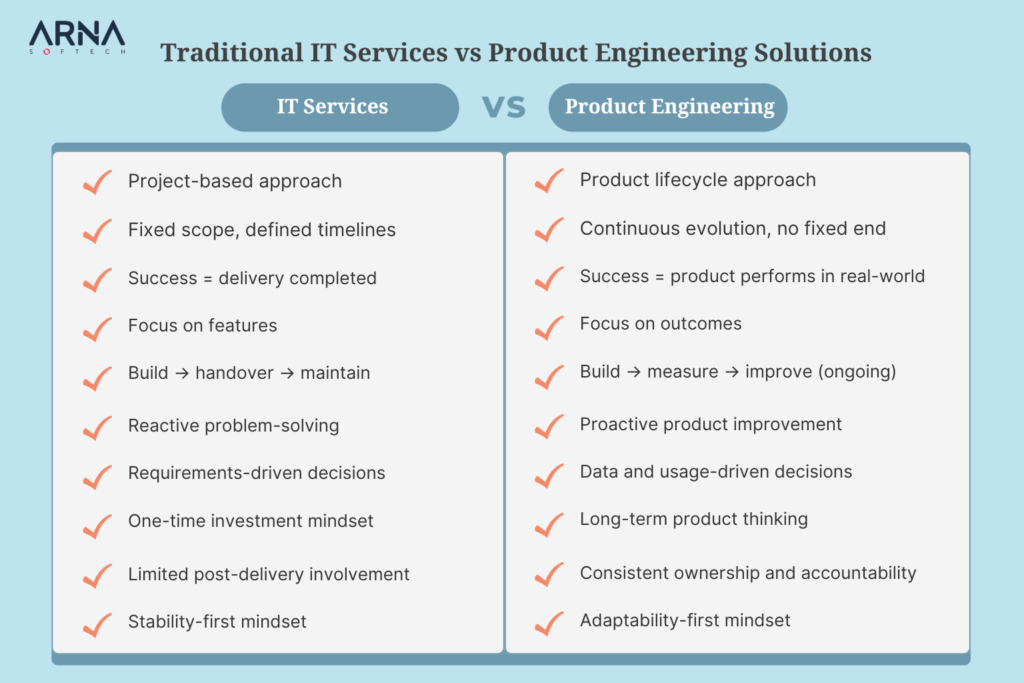
Traditional IT services are built around stability and maintenance. Product engineering solutions, on the other hand, are built around continuous evolution. They focus on building and enhancing products in a way that keeps up with real user needs and market changes.
Let’s get into 3 major reasons why this change is happening and why product engineering solutions are becoming the go-to approach for building modern digital products.
Transition to Product Ownership Mindset
It’s not about delivering features anymore. It’s about owning outcomes.
Traditional IT services are structured around:
• Clear scopes
• Defined timelines
• A finish line everyone is working toward
Once the delivery is done, the engagement goes into support or maintenance mode.
But successful products don’t operate in fixed timelines. They grow based on how users interact with them, what the market demands next, and where the business wants to go. There’s no real “end” to the work, only the next version that needs to be better than the last.
Teams aren’t just executing requirements; they’re consistently involved in improving the product. Their thinking revolves around:
• Performance
• Usability
• Scalability
• Long-term impact
Decisions aren’t driven by initial specifications alone, but by real-world usage and outcomes.
And for businesses, this means they’re no longer investing in isolated development efforts. They’re building products with a sense of ownership behind them, products that are actively shaped.
Traditional IT Services vs Product Engineering Solutions
Direction Matters More Than Speed
For years, businesses expected IT teams to move faster across releases, fixes, and delivery. And conventional IT services responded by optimising for speed within defined scopes.
However, moving fast doesn’t help if you’re moving in the wrong direction. Products often fall short because they don’t quite match what users need or what the business ends up needing a few months later. By the time those gaps become visible, the cost of fixing them is already high.
This is where product engineering solutions take a more grounded approach. Instead of only thinking about speed, the thinking pivots to whether it makes sense to build it that way in the first place.
There’s more emphasis on:
• Feedback loops
• Real usage data
• Continuous validation
Features are observed, refined, and sometimes even rolled back if they don’t land well. The direction keeps getting corrected as the product grows.
Real Value Comes from Solving Workflow Problems
One of the biggest limitations of traditional IT services is that they often stop at building what’s asked. The features are delivered, but the underlying business problem? That’s not always fully solved.
Product engineering solutions approach this very uniquely. The starting point isn’t what needs to be built, but what needs to work better.
A good example of this is the following .NET Product Engineering project we worked on.
On the surface, the requirement was simple: Create a system to manage surveys and collect field data. But when we looked deeper, we discovered a much more complex issue.
From survey distribution to response analysis, the entire process was slow and fragmented. Instead of just building a basic data collection tool, our focus shifted to rethinking the workflow itself. The system we designed:
• Made form creation and sharing more efficient
• Simplified how data was gathered in the field
• Made reporting far more accessible and structured
That’s the difference.
Traditional IT would have delivered a functional system. Product engineering looked at the bigger picture:
• How the system aligns with everyday operational workflows
• How users interact with it
• Where the friction is.
Learn how this project came together here.
The New Product Mindset
More than anything else, what stands out is how much the business perspective on technology has changed. It’s not sufficient to build systems that are functional. They need to adapt and deliver value as the business grows.
That’s why this transition isn’t temporary. It’s becoming the new normal.
If you’re thinking about custom digital product engineering solutions, consider building a product that supports changing business goals. Begin with a simple conversation about what your product needs next.
What are Custom Digital Product Engineering Solutions?
The idea behind these solutions is building a product that fits your business and refining it over time. Instead of using a standard approach, everything is shaped around how you work and what you need. As your business grows or your users’ needs change, the product keeps up with the changes.
Does This Make Things Slower?
It can feel that way initially, but it often ends up moving things faster. A bit more thought early on means less fixing later.
Is This Approach Only Useful If I’m Building a New Product?
Not at all. It works just as well for existing products. In fact, many businesses adopt this approach when their current systems start feeling slow or hard to update.