Your 30-Second Summary
Scaling AI exposes how your business actually runs. Not how it’s documented. Not how it’s expected to work. But how decisions are made, how data flows, and where inconsistencies exist. Because once AI becomes part of the workflow, it starts interacting with all of it.
To understand how AI scales, we’ll look at:
• Why AI starts to lose reliability as it scales
• What drives consistency across workflows and teams
• A 5-step approach to scale AI in a controlled, repeatable way
A survey conducted by McKinsey reveals close to two-thirds of organisations haven’t moved beyond initial AI efforts to scale it enterprise-wide. So what’s causing the slowdown?
It’s usually easy to make AI technology work in one business workflow. The data is cleaner than usual. The scope is controlled. It’s much harder to make it work across the entire organisation. What changes is not just the size of the problem. It’s how the problem behaves.
That’s why scaling AI isn’t just an extension of building it. It requires a different way of thinking altogether, one that focuses on how AI fits into real work, across the organisation, and how that can be made repeatable. Together with the right AI development company, here’s what it takes to scale AI effectively across an enterprise.
Why Doesn’t AI Scale Easily?
Once AI moves beyond initial use, the challenge becomes making it work consistently across the organisation. Here are the key factors that make expanding AI solutions difficult for most enterprises.
1. Workflows Vary More Than Expected
Two workflows may look identical at a high level. The difference shows up in real use.
Teams interpret inputs differently. They follow slightly different decision paths. Exceptions are handled in ways that are rarely documented. AI development relies on patterns. When those patterns are not consistent, what worked well in one workflow cannot be applied as is to another.
2. Data Reliability Does Not Hold at Scale
Most organisations have enough amount of data to get started. The issue is that data is not consistent across systems and teams.
At a smaller scale, teams compensate for this through manual corrections and context awareness. At scale, differences in structure, missing fields, and lack of standardisation lead to unstable outputs.
3. Initial Success Is Not Systemised
Initial AI development wins usually come from focused effort. As scaling begins, the same level of coordination and clarity is harder to maintain. And more importantly, what worked is rarely captured in a way that others can reuse.
There is no standard way of approaching similar problems. So every new AI system initiative ends up starting from scratch. This slows progress because the enterprise fails to convert early success into something repeatable.
5-Layer Framework for Scaling AI Systems
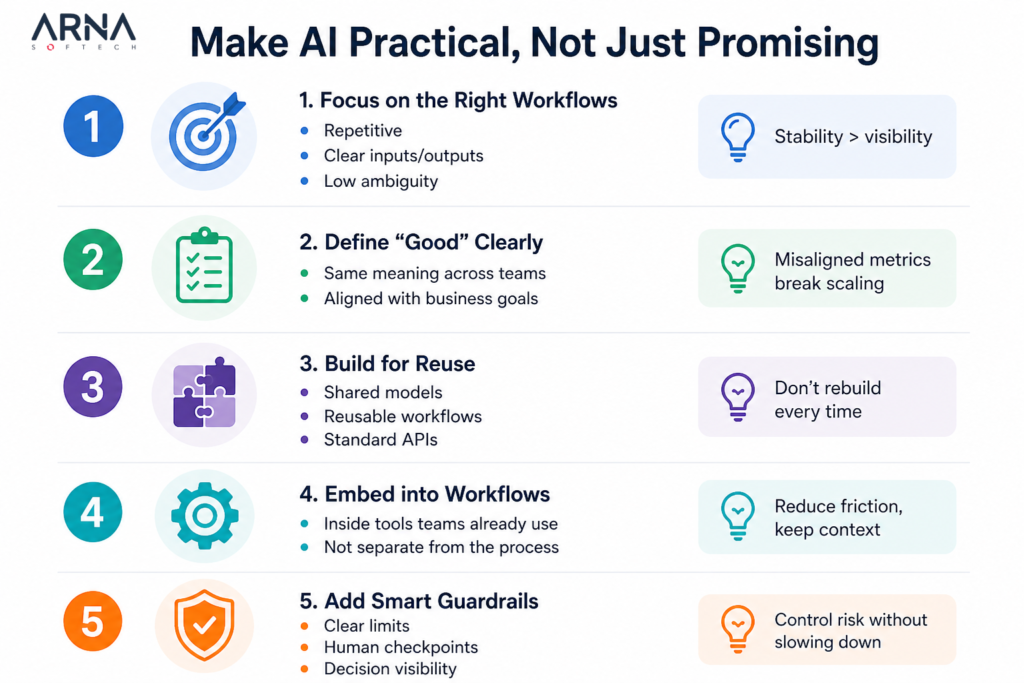
Layer 1: Find High-Impact Workflow Opportunities
Check for workflows where underlying patterns are stable, even if surface-level inputs vary. For example, processes with:
• Repeatable decision structures
• Clearly defined inputs and outputs
• Limited ambiguity in interpretation
These are far more scalable than workflows that rely heavily on context, judgment, or exceptions. The mistake most teams make is choosing workflows based on visibility of impact, not stability under variation. When we talk about implementing AI at scale, stability matters more.
Layer 2: Standardise What “Good” Looks Like
A metric that works in one team often doesn’t translate across others.
Take something like “faster turnaround time.” In one workflow, speed might be the priority. In another, accuracy or compliance might matter more. If AI is refined for speed in one context, it can create risk in another. This is where scaling breaks, because success is defined differently across environments.
To scale successfully, you need outcomes that are:
• Interpretable across teams
• Consistent in meaning
• Aligned with business-level priorities
Layer 3: Build Reusable AI Components
This layer isn’t just about the duplication of effort alone. It’s the lack of shared foundations. To scale AI solutions seamlessly, you need to move toward reusable building blocks:
• Shared access layers to models so teams aren’t integrating them differently every time
• Reusable prompt patterns and workflows that capture what already works
• Standardised APIs that make AI capabilities accessible across systems
Reuse doesn’t happen automatically. It needs to be designed. That means standardising the underlying systems as well:
• How data is prepared and passed into models
• How outputs are evaluated and validated
• How deployments are managed across environments
Layer 4: Make AI Part of Execution
AI integration is about how much friction it removes or introduces at the point of execution. Strong implementations focus on embedding AI directly into existing systems:
• Inside CRMs, where sales teams already update and review data
• Within support platforms, where tickets are created, triaged, and resolved
• In internal dashboards, where decisions are made based on live data
• Across developer environments, where code is written and reviewed
The point is that AI should replace or reshape a step in the workflow, not sit alongside it.
Another important factor here is context preservation. You have to ask: does it have the right context to work correctly wherever it’s used?
Standalone tools often lose context, users have to explain the same thing repeatedly. Embedded systems inherit context from the workflow itself, like customer history, task state, prior actions. That’s what makes the solutions more workable across different settings.
Layer 5: Build Guardrails That Don’t Block Progress
As AI moves deeper into workflows, the risk profile changes. Errors may be contained at a small scale. But they can compound at scale. This is especially true for regulated environments where decisions have compliance implications.
What works better is built-in guardrails:
• Defined boundaries on where AI can act autonomously
• Clear checkpoints where human validation is required
• Transparency on how outcomes are reached
This is where AI consulting services play an important role, not just in building systems but in embedding the right checks into them.
Wrapping Up
If AI is working in a few areas but not across your business yet, the right approach and partner can help you move forward. Our AI development services help you move you from individual use cases to well-structured, dependable systems. Reach out to us to discover how this could work for your enterprise AI scaling.
What is AI Development?
AI development is creating systems that can understand, decide, and improve. Instead of telling it every step, you train it with data.
How to Develop AI Software?
Start by asking: where is work too manual? Then take your existing data, make it usable, and bring AI into the process.
What Infrastructure Helps AI Automation Grow?
You need:
• Data infrastructure for clean and consistent inputs across workflows
• Integration layers that connect AI with your existing tools
• Monitoring and feedback systems to track performance and improve outputs over time
An experienced AI automation consultant helps bring this together.