Your 30-Second Summary
The EdTech businesses that evolve well usually have one thing in common: a platform built to support growth across multiple institutions. In this blog, we’ll explore how businesses can build such an LMS platform using modern Microsoft technologies and cloud-ready architecture. We cover:
• Understanding how multi-tenant LMS platforms work
• Exploring the role of .NET, Angular, SQL Server, and Azure
• Key features every multi-tenant LMS platform should include
• Insights from a US-based multi-tenant LMS project we delivered
When your LMS is built with shared SaaS architecture, every institution gets its own environment, branding, and data. That’s the kind of LMS that actually scales.
.NET Core and Angular give you the right foundation to build it. It’s why EdTech businesses that want to build in multi-tenancy from day one hire dedicated .NET developers for their practical expertise in the same.
Understanding the Tech Stack Behind a Modern LMS
Not every tech stack is built for what a multi-tenant LMS demands. The requirements are specific: clean data isolation, effortless scaling, and consistent experiences per tenant.
Here is the tech stack used by our .NET development company that makes it all work.
.NET for Performance and Security
When you’re running an LMS across multiple institutions, the backend needs to be rock solid. .NET delivers that with platforms that can support:
• Large user traffic
• Multiple institutions
• Growing data volumes
• Cloud-based deployment
Angular for a Better Learning Experience
Learners notice the frontend more than anything else. Angular development services help create:
• Smoother navigation
• Responsive learner dashboards
• Mobile-friendly architecture for accessibility across smartphones and tablets.
(The growing demand for .NET MAUI mobile development signals a shift in EdTech towards dedicated native apps for iOS and Android.)
Microsoft SQL Server for Structured Data Management
Cloud-based development with Azure gives LMS platforms more flexibility to grow. As usage increases, resources can scale without affecting performance or forcing major infrastructure changes. Azure takes a lot of infrastructure pressure off your team by:
• Automatically scaling server resources
• Managing growing learner traffic
• Improving platform uptime availability
• Supporting cloud-based LMS deployment
• Reducing manual server management
Microsoft Azure for Scalability and Availability
With complete notes from past interactions, agents spend less time getting up to speed and more time solving customer problems. They can continue resolving issues from where the previous discussion stopped. This makes the support experience feel much smoother for the customers.
Automatically scaling server resources
• Managing growing learner traffic
• Improving platform uptime availability
• Supporting cloud-based LMS deployment
• Reducing manual server management
Inside a Multi-Tenant LMS We Built for a US-Based Educational Business
We worked with a USA-based educational business that was managing multiple institutions on a fragmented system. Each institution had its own set of users, course structure, and learning environment. They needed one scalable platform that could handle everything cleanly, without sacrificing the separation each institution required.
What Arna Softech Built?
As an expert .NET development company, we developed a multi-tenant LMS using .NET Core, C#, Angular, SQL Server, and Azure.
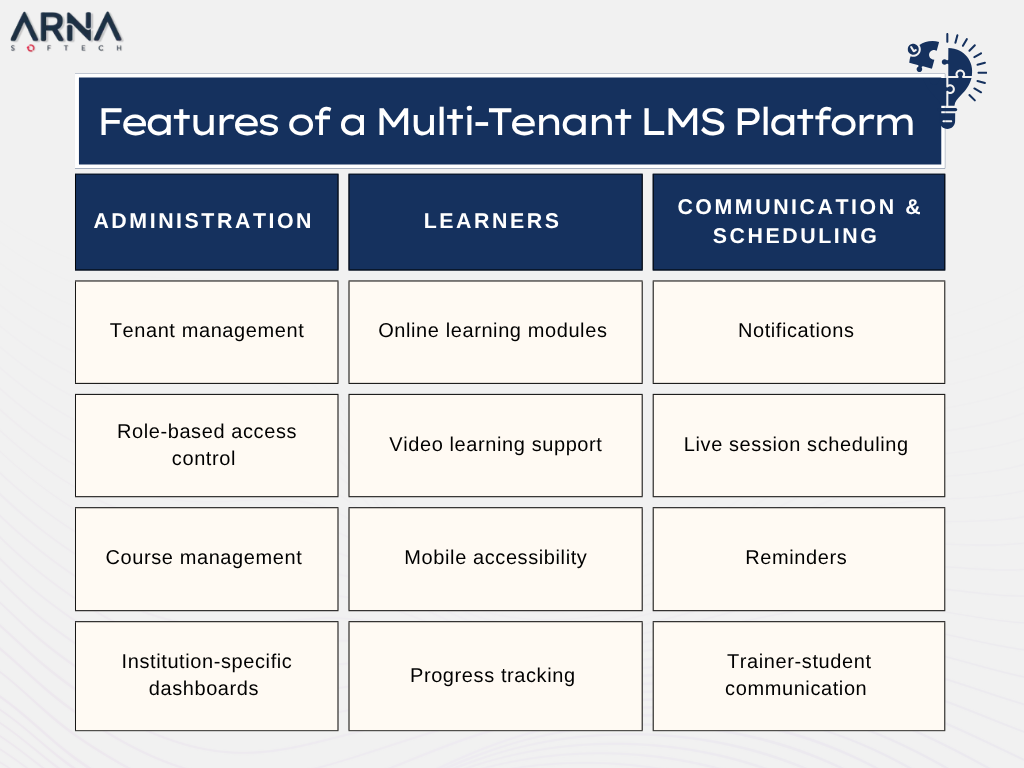
Each institution got its own completely isolated environment on the platform. It offered tenant-specific dashboards giving admins full visibility and control over their own space, without any access to other tenants’ data or operations.
Operational Transformation
Access across the platform was structured around clearly defined roles:
• Admin dashboards gave institution managers control over users, courses, scheduling, and reporting.
• Learner dashboards ensured content access was restricted based on learner classification.
• Course management was built to support courses and subcourses, so institutions could structure complex learning paths properly.
• aOnline class scheduling enabled instructors to plan and manage live sessions without needing a third-party tool.
Conclusion
Digital learning platforms are growing fast. EdTech businesses now need scalable LMS solutions that can support multiple institutions and growing user demand. These platforms make daily operations easier and more scalable.
Businesses that hire ASP.NET developers can build secure and scalable LMS platforms with better performance and centralised management.
If that’s the kind of platform you’re looking to build, we’re the right team to build it with. Get in touch, and let’s discuss your platform idea.
Frequently Asked Questions (FAQs)
What is .NET in Software Development?
.NET is a software framework from Microsoft. It’s used to develop web, cloud, desktop, and enterprise applications.
Is Angular an SDK?
No, it is a front-end web application framework by Google. It helps build dynamic and interactive user interfaces for web applications.
Why Choose .NET Outsourcing for LMS Development?
Partnering with a .NET development company helps businesses build LMS platforms faster while reducing hiring and development costs. Learn more in this detailed .NET outsourcing guide.