Arna Soft

Fintech App Development – Features, Technologies & Considerations

By Arnasoftech

Feature Image for Blog - Fintech App Development - Key Features, Technologies & Considerations

Fintech application development means creating software that enables a financial product or process to work digitally. This could be a payment app, lending platform, banking application, investment platform, or an internal operations system.

Applications built for financial services cannot be approached like regular ones. What sets them apart is what’s on the line. A fintech application handles money, sensitive information, and rules. An issue that might be a minor inconvenience in conventional software can become an operational or compliance problem in finance software. That changes how the application needs to be designed, developed, tested, and scaled.

Let’s look at the key features, technologies, and considerations that go into building the app.

Types and Core Features of Fintech Applications

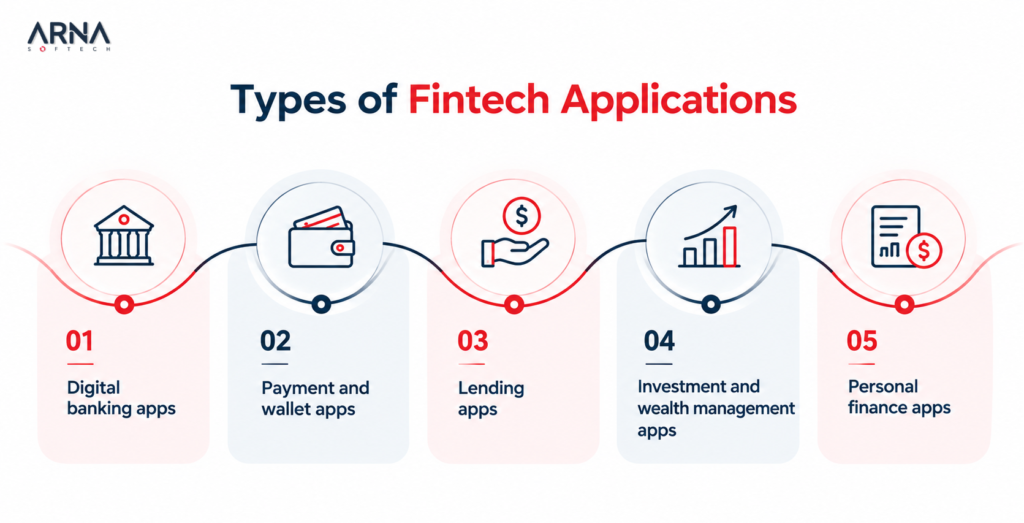
The most common types of fintech solutions include:

  • Digital banking apps
    Bring services such as account management, transfers, bill payments, and card management into a digital experience.
  • Payment and wallet apps
    Let users store payment information, send and receive money, and make digital payments.
  • Lending apps
    Digitize the borrowing journey from loan applications and eligibility checks to disbursement and repayment.
  • Investment and wealth management apps
    Help individuals or advisors manage investments, portfolios, transactions, and goals.
  • Personal finance apps
    Bring information together to help users track spending, manage budgets, and make better decisions.
The features depend on the type of app. Some are common across apps, while others are specific to the service it supports. The core feature set typically includes:

  • Automated workflows
  • Transaction processing
  • Notifications and alerts
  • Reporting and analytics
  • AI-powered financial insights
  • KYC and identity verification
  • Account and profile management
  • Fraud detection and risk controls
  • Transaction history and statements
  • Secure user authentication and access controls
  • Secure integrations with banks, payment providers, data platforms, and other external systems

Technologies Used in Fintech Custom Software Development

The stack can include frontend and backend technologies, databases, cloud platforms, APIs, and security tools. AI and ML can be added where they can help with fraud detection, risk analysis, document processing, or insights.
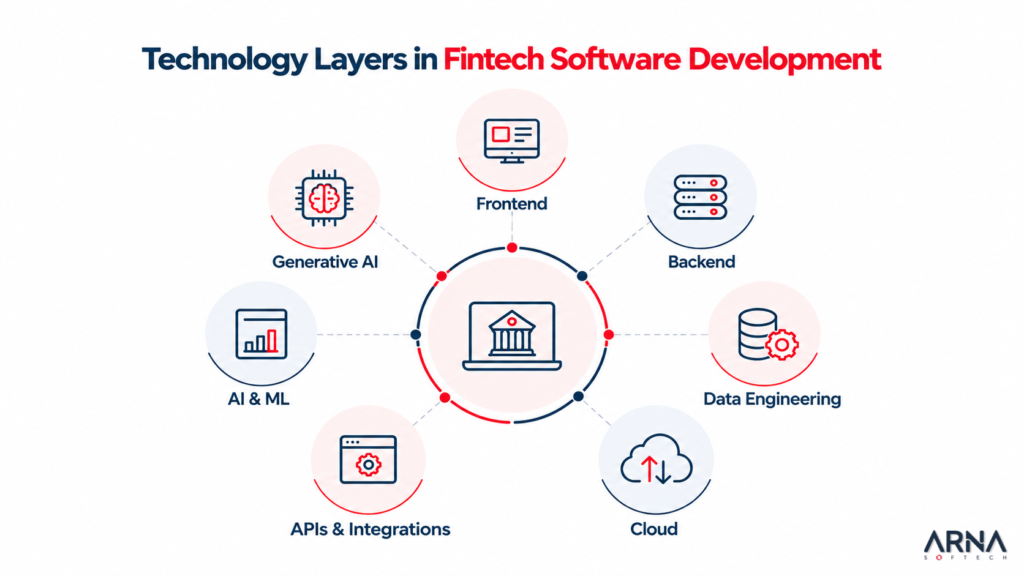
Technology Layers in Fintech Software Development

There’s no single technology stack that works for every product. The right choices depend on the type of transactions involved, the data being handled, the integrations required, and the transaction volumes it must support.

Technology Layer How It Is Used
Frontend
Customer-facing banking apps, dashboards, portals and mobile applications
Backend
Transaction processing, account management, lending workflows and core business logic
Data Engineering
Building data pipelines, integrating and preparing data for analytics and AI
Cloud
Application hosting, cloud infrastructure, scalability, data storage and disaster recovery
APIs & Integrations
Connecting with banks, payment providers, KYC platforms and other systems
AI & ML

Fraud detection, credit & risk analysis, predictive analytics, and data analysis

Generative AI
Document processing, data extraction, intelligent assistants and automated workflows

There’s no single technology stack that works for every product. The right choices depend on the type of transactions involved, the data being handled, the integrations required, and the transaction volumes it must support.

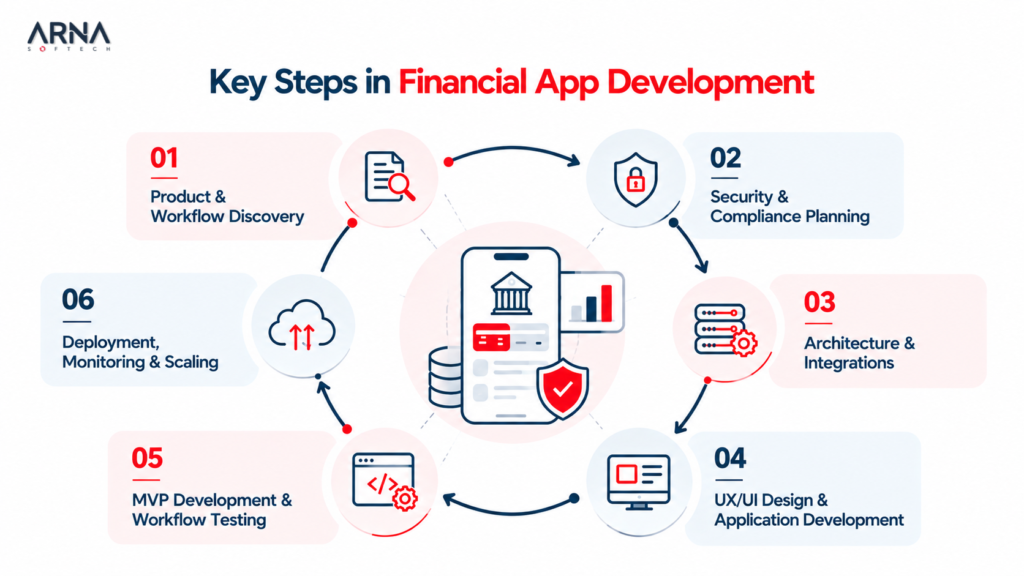
Key Steps in Financial App Development

Financial software solutions cover very different needs, and that matters when deciding what to build, buy, or integrate.

1. Product & Workflow Discovery

The first step is to translate the financial product into clear digital workflows.

Look at what the customer does, what happens behind the scenes, how transactions are started & completed, and which business rules drive each step. Also identify the systems and data sources involved.

2. Security & Compliance Planning

Security needs to be built into how the product handles money, data, and access. Build in secure logins, data protection, access controls, and audit logs to meet compliance requirements.

3. Architecture & Integrations

This is where the application’s different technology pieces and external systems come together.

The architecture needs to support the core workflows and provide reliable connections to banks, payment gateways, identity verification services, data platforms, and other third-party systems.

Key Steps in Financial App Development

4. UX/UI Design & Application Development

Users shouldn’t have to deal with the complexity happening behind the scenes.

A user making a payment should clearly understand the amount, status, and outcome. Someone applying for a loan should know what information is needed and what happens next. The development layer then connects these experiences to the systems working behind them.

5. MVP Development & Workflow Testing

Build around core financial workflows that need to work from day one. Testing should then cover both successful and unsuccessful scenarios.

Think about cases such as failed transactions, incorrect customer information, unavailable third-party services, or duplicate requests. Testing them helps identify issues before the product scales.

5. Deployment, Monitoring & Scaling

After the app goes live, monitor how it performs with real users and activity.

Keep track of transaction failures, API and integration issues, system speed, and unusual activity. This helps the team spot problems early and make the right changes as the number of users and transactions increases.

What Should You Consider Before Building a Fintech App?

A few decisions made before development can have a big impact on how the app is built. Start with these:

  • Financial Services – What are you enabling? Payments, lending, banking, investing, or something else?
  • Users & Geography – Who are your primary users, and which countries or regions will you serve?
  • Regulations – What compliance requirements does the product need to meet?
  • Security – How will you protect data, user accounts, and transactions?
  • Integrations – Which financial and third-party systems will the app depend on?
  • Transaction volume – What transaction load should the application support?
  • Scalability – How will the system handle growth in users and transaction volumes?
  • MVP scope – What is essential for the first version, and what can come later?

Building a Financial Services App? Let’s Build It Together

We have worked across the landscape, from digital banking and payments to lending, trading, wealth management, and BaaS. Our hands-on experience helps us understand the user journeys, business needs, and challenges behind each application.

Have a project with a unique challenge? Reach out to us and leverage our years of industry perspective.

Frequently Asked Questions (FAQs)

What is the Cost for Developing a Fintech Application?

The cost of developing such an application generally falls between $30,000 and $500,000+. Complex financial workflows are one of the main reasons some applications cost more to develop. Banking, payments, lending, and trading products are good examples.

The core features of a banking app are

  • Digital account opening and KYC
  • Secure authentication and user access
  • Account, balance, and transaction management
  • Payments, transfers, and scheduled transactions
  • Card issuance and management
  • Real-time transaction notifications
  • Fraud monitoring and suspicious activity alerts
  • Statements and financial reporting
  • Customer service and issue resolution

Before choosing a development partner, look beyond development capabilities and consider how they approach the product as a whole:

  • Expertise – Have they built products similar to yours and understand the workflows involved?
  • Technical and regulatory capability – Can they build around the regulatory and security requirements of your target market?
  • Track record and partnership – Can they show relevant fintech projects, outcomes, and client experience?
Table of Content​
Get in touch

Looking to transform your legacy application with modern technologies? let us know how we can help you.

Subscribe to our newsletter

Get the latest updates on stream processing and tech insights.

Other Blogs
The smartest financial software isn't always built from scratch. Learn when to build, integrate, or buy.
Software Development Company
employer branding
custom software development
digital transformation
Custom Financial Software, Finance Software, Financial Services Technology, Financial Technology Solutions
Here’s what fintech software can solve for business leaders handling large data volumes.
Software Development Company
employer branding
custom software development
digital transformation
Custom Financial Software, Finance Automation, Finance Software, Financial Data, Financial Reporting, Power BI

Have a Challenge in Mind?

We’d love to hear about it.