Let’s look at an AI powered trading platform we developed for a client.
The goal was to build custom financial software that automated the decision-making and execution involved in the trading process, based on the client’s own trading logic and years of industry experience.
This wasn’t just about building software and adding automation to it. The solution had to reflect the client’s financial workflows, support real-time processing of financial data, and automate the steps according to the client’s own rules.
How We Built the Custom Trading Platform
We designed the platform around a single connected flow:
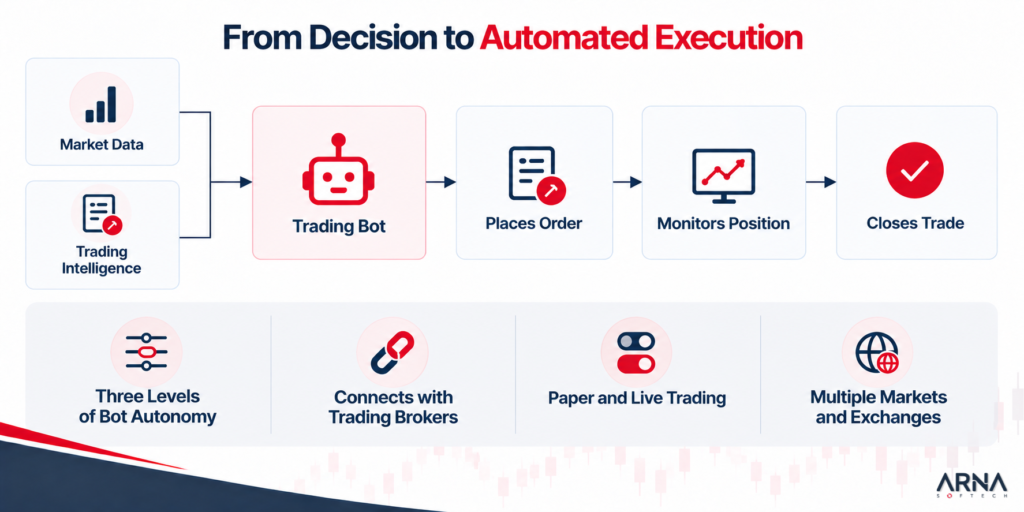
Market data → AI analysis → Trading intelligence → Strategy → Execution → Monitoring
- Market data
The platform collected live market data alongside historical data, then validated and prepared both for analysis. - AI/ML analysis
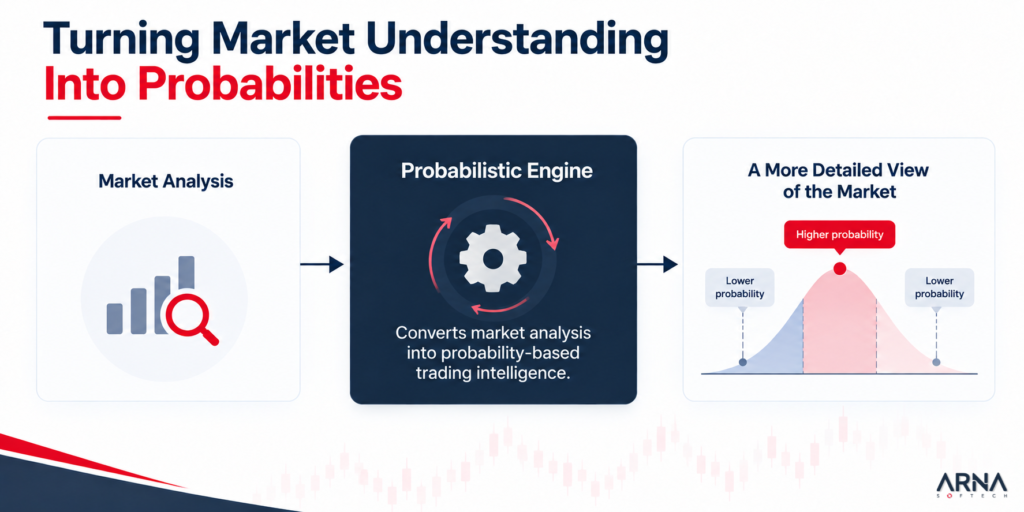
The system analyzed current data against historical market behavior to identify patterns and market conditions. - Trading intelligence
These insights were converted into probability-based signals that could inform the next action.
- Strategy and risk
Trading opportunities were evaluated against predefined strategy and risk rules before execution. - Execution
The trading bots received the data and intelligence needed for execution. They placed and managed trades through connected brokers & exchanges. - Monitoring
The system continued to evaluate trades after execution, tracking outcomes and checking whether market conditions still supported the original decision.
Engineering the Platform Around Custom Financial Requirements
The custom aspect of software comes from how deeply it reflects the process it is built for. For this automated trading system, three areas were particularly important:
- Financial Data
Market data was validated and analyzed to generate metrics, identify market conditions, and produce trading intelligence. This made the data pipeline part of the custom trading logic. - Integrations
The custom integration layer connected the different systems needed to automate the trading workflow. This included connections with brokers and exchanges, allowing the platform to work across the external systems involved in trading. - Risk and Operational Control
Automated financial software needs strong risk controls, reliability, and auditability built into the workflow. For this platform, that meant pre-trade validation, continuous monitoring, and emergency controls. Every trade could also be traced back through its data and decision history.
Scaling the Trading Operation With Automation
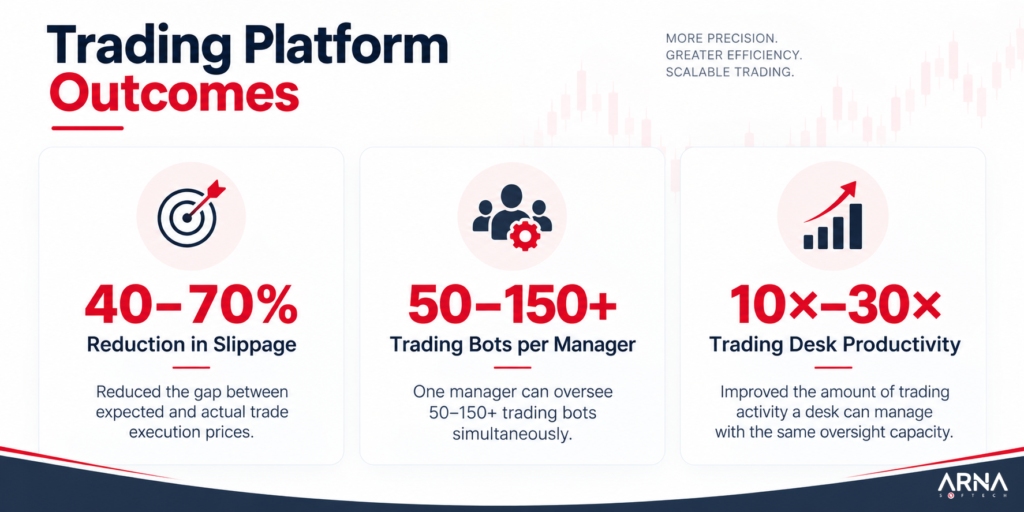
Scalability is one of the strongest reasons to build custom fintech software. The architecture can be designed around the level of automation and operational capacity the business needs to reach. In our trading platform, this meant supporting 50–150+ trading bots under a single manager, showing how custom architecture can increase capacity without increasing manual oversight at the same rate.
The value of going custom became clear in how the platform transformed the trading operation. It delivered 40–70% lower slippage, enabled one manager to oversee 50–150+ trading bots, and improved trading desk productivity by 10X–30X.
The advantage of custom fintech applications goes beyond having software built to specification. They can capture the financial knowledge and decision-making logic that make a business different, and turn that into a system that can analyze, decide, automate, and act.